
Updated November 2026 · Written and maintained by the Progression Agency strategy team
Progression Agency builds healthcare apps and software for practices, clinics, digital health startups and health-adjacent businesses: patient scheduling, telehealth, secure messaging, remote monitoring, wellness and internal clinical tools. Our mHealth app development services cover the patient’s phone as well as the clinician’s view behind it. A health care app development company earns trust in the first workshop, when it asks who touches each piece of data (patient, clinician, front desk, billing) before anything is sketched. We design for patients and clinicians, build with privacy and security at the core, and plan for HIPAA, EHR integration and app-store health policies from the first workshop.
Healthcare App Development from Progression.
Get your exact price in a free proposal, usually the same business day.
Get a free proposalOn this page · 10 sections
- What does a healthcare app development company do?
- Healthcare app development services
- HIPAA and healthcare app compliance
- Security we build into healthcare software
- EHR integration and interoperability
- How much does healthcare app development cost?
- Why choose Progression Agency for healthcare apps?
- Must-have features in healthcare apps
- Healthcare app users and what each needs
- Accessibility in healthcare apps
The short answerA healthcare app development company builds medical and health apps that handle sensitive data safely and fit clinical workflows. Whether HIPAA applies depends on who the app serves: apps built for or on behalf of a covered entity such as a provider or health plan handle protected health information and require HIPAA safeguards and a business associate agreement, while many consumer wellness apps fall under the FTC’s Health Breach Notification Rule instead. Progression Agency determines which rules apply during discovery and builds accordingly.
This page describes how we approach regulated health software. Regulatory descriptions reference HHS, FTC, FDA and ONC guidance as of September 2026. Cost ranges are market figures, not quotes.

What does a healthcare app development company do?
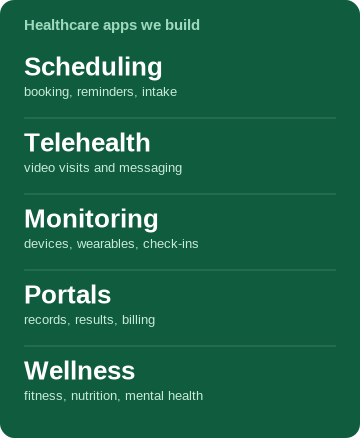
It designs and builds medical and health software that is secure, compliant and usable by patients and clinicians: from scheduling and telehealth to monitoring and portals, including integrations with electronic health records and the privacy safeguards the data requires. A health mobile app has a constraint a desktop portal does not: a phone gets lost, shared or borrowed, so data on the device needs its own plan. Our healthcare application development services continue after launch, because operating system updates, EHR version changes and store policy revisions can each break a working app. Ask a custom healthcare app development company to keep a record of which screens store or send patient information, updated with each release, so a privacy review or a hospital partner’s security questionnaire can be answered from it. A healthcare mobile app development company that also builds the web portal can keep one sign-in, one data model and one security review across phone and browser; Progression designs, builds and maintains the iOS, Android and web versions together under one written scope.


Healthcare app development services
Patient scheduling and intake apps
Online booking, reminders, digital intake forms and insurance capture that reduce no-shows and front-desk workload. Medical mobile application development for booking usually has to read and write to the practice’s existing scheduling system, so confirm early that the system offers an interface the app can use. A healthcare mobile app developer should ask for a test account on that scheduling system before quoting, since a missing or limited interface changes the estimate more than any screen design.
Telehealth and virtual care
Video visits, secure messaging and asynchronous check-ins built on HIPAA-eligible video and messaging services.
Remote patient monitoring
Apps that collect readings from connected devices and wearables through Apple HealthKit and Android Health Connect and surface trends to care teams. A medical Android app needs testing across more device makers and OS versions than an iPhone build, since patients keep older phones and manufacturers change how background sync behaves.
Patient portals
Results, records, messaging and bill pay in one place, integrated with your EHR.
Wellness, fitness and mental health apps
Consumer health apps with subscriptions, content and tracking, built with the privacy expectations and store policies that apply to health data. Mobile health application development for this category depends as much on return visits as on features, because a tracking app that asks for daily entries needs reminders and a clear reason to come back or it is quietly abandoned.
Clinical and operational tools
Internal apps that streamline documentation, handoffs, inventory and reporting for care teams, often as part of wider custom software.
Healthcare mobile app builds beyond a vendor template
Templates suit a practice that wants booking and reminders under its own logo. Custom work fits when the app must follow your own care pathways, exchange data with your EHR in both directions, or change on your release schedule. A digital health app sold to consumers or employers goes further: the subscription logic, tracking data and roadmap are the business itself, so owning the code matters more.
Hospital mobile app for visitors, wayfinding and departments
The audience is wider than a clinic’s: inpatients, visitors, outpatients booking across departments, and staff. The EHR vendor’s patient app usually comes first and covers records well, so a separate hospital app earns its place through what that product leaves out, such as indoor maps, parking, visiting rules and department-specific prep instructions. We build those pieces and link into the existing patient login rather than duplicate it.
Should mobile apps in the healthcare industry be native or cross-platform?
Usually a shared codebase, written once in React Native or Flutter, with native Swift or Kotlin modules added where the app depends on sensors, Bluetooth medical devices, background sync or secure storage. We make that call feature by feature in custom health app development: booking, messaging and education screens behave alike on both phones, and writing them twice adds cost without adding anything a patient would notice.
Health data is one of those native pieces. Apple HealthKit and Android Health Connect belong to each phone’s operating system rather than to the shared code, so mobile health app developers working cross-platform still write platform code to read them and revisit it when Apple or Google revise those interfaces. A quote for healthcare mobile app development services should price the shared app and the native modules as separate lines, since the modules are what keep device readings flowing.
Android healthcare application development adds one more native piece when patients fill in forms on a waiting-room tablet. Android’s lock task mode keeps a managed device on one approved app, so a patient stays in the intake screens instead of returning to the home screen, opening notifications or switching to other apps. That setup is agreed with whoever manages the clinic’s devices before the first tablet reaches the front desk, along with how the app clears one patient’s answers before the next person picks it up.
HIPAA and healthcare app compliance
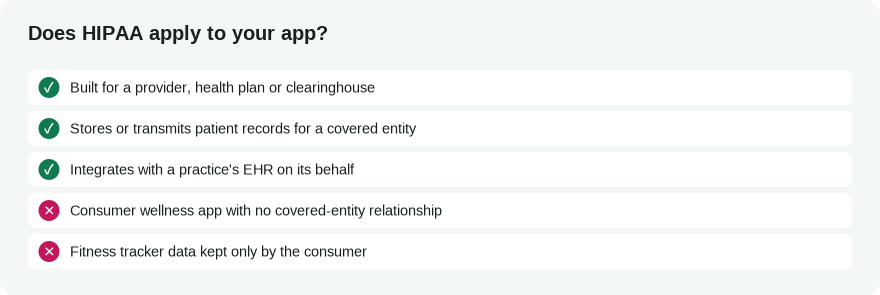
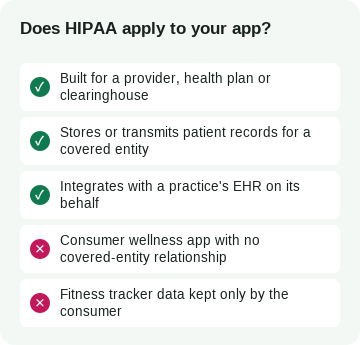
HIPAA applies when an app creates, receives, maintains or transmits protected health information for or on behalf of a covered entity, making the developer a business associate. Many direct-to-consumer wellness apps are not covered by HIPAA but are subject to the FTC Health Breach Notification Rule and state health-privacy laws.
| Rule | Applies when | Agency |
|---|---|---|
| HIPAA Privacy and Security Rules | The app handles PHI for a covered entity | HHS |
| FTC Health Breach Notification Rule | Consumer health apps not covered by HIPAA | FTC |
| FDA digital health oversight | Software that functions as a medical device | FDA |
| ONC interoperability and information blocking | EHR data access and exchange | ONC |
| App Store health rules | Apps using HealthKit or health data | Apple |
We identify which rules apply during discovery, sign business associate agreements when we handle PHI and host on HIPAA-eligible cloud services under the provider’s BAA. Health app developers on your shortlist should be able to map where patient data travels, from the phone through the API to storage, including analytics and crash-reporting tools that can receive it without anyone noticing. AI medical apps add a stop to that map: patient text sent to a model provider leaves your own servers, so the provider needs the same agreement review as the host.

Security we build into healthcare software
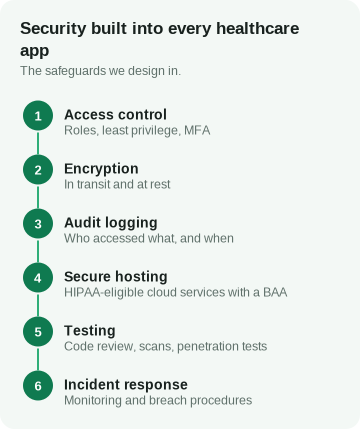
- Role-based access with least privilege and multi-factor authentication.
- Encryption in transit and at rest.
- Audit logs of access to health information.
- HIPAA-eligible hosting on AWS, Azure or Google Cloud under a BAA.
- Code review, dependency scanning and penetration testing before launch.
- Incident response and breach notification procedures documented.


Custom healthcare software application development
That work covers more than screens: hosting, logging and access rules are chosen early so the controls above are built in rather than reviewed at the end.
Healthcare web app development adds its own concerns, such as session timeouts on shared clinic computers and patient data lingering in a browser cache. Hold any healthcare app development company in the USA to those details, and ask how they get tested before launch. A mobile build has the phone-side version of those concerns, so a medical mobile app developer should be able to say how locked-screen notifications, local storage and biometric sign-in are handled for patient data. Android healthcare app development also has to plan for notifications and background sync, which some device makers restrict to save battery, so reminders should be tested on a range of phones.
EHR integration and interoperability
We integrate with electronic health records using HL7 FHIR APIs and SMART on FHIR app launch where the EHR supports them, and through vendor-specific APIs or integration engines where it does not.
Standards documentation: HL7 FHIR and SMART Health IT.
What patient data does a medical app developer test with?
Synthetic records, so real patient information stays out of development laptops, test servers and bug reports. Synthea, an open-source synthetic patient generator, produces realistic but fictional medical histories, with medications, allergies and encounters, exported in HL7 FHIR, C-CDA and CSV. That lets healthcare app developers exercise a medication list or an allergy alert months before a clinic connects its own system.
Integration code follows the same rule. Where the EHR vendor offers a sandbox or test instance, the connection is proven there first, against records shaped like the clinic’s own, so a field that arrives empty or in an unexpected unit shows up in testing rather than in a live chart. Medical app development services that plan this access early keep the launch date realistic, since the clinic’s production system is the last place anyone wants to find a mismatch.
How much does healthcare app development cost?
At market rates, a focused healthcare MVP commonly costs roughly $60,000-$150,000, a full-featured patient or telehealth app roughly $150,000-$350,000, and complex platforms with EHR integration and device connectivity more. Compliance, security testing and integrations are the main drivers above a standard app. Treat these as published US price bands (market ranges only).
| Scope | Typical range | Timeline |
|---|---|---|
| Wellness app MVP | $50,000-$120,000 | 3-5 months |
| Scheduling / intake app | $60,000-$150,000 | 3-6 months |
| Telehealth app | $120,000-$300,000 | 5-9 months |
| Platform with EHR and devices | $250,000+ | 8-14 months |
More detail in app development cost.
Get a free proposal with your exact price, usually the same business day.
Why choose Progression Agency for healthcare apps?
- Compliance classification in discovery, before design begins.
- Security safeguards designed in, not added at the end.
- Accessible, patient-friendly design to WCAG 2.2.
- Experience across mobile, web, backend and integrations under one team.
- Healthcare marketing expertise: see medical marketing and healthcare website design.
- Headquartered in New York City, working with health organizations nationwide and worldwide.
Must-have features in healthcare apps
Healthcare apps succeed when they save patients and staff time without adding risk. These are the features we are asked for most.
Secure login and identity verification
Multi-factor authentication, biometric sign-in on the device and, where required, identity proofing for new patients. Mobile app development for healthcare also has to plan for the shared family phone, so a session should close when the app does and notifications should never show clinical details on the lock screen.
Appointment scheduling and reminders
Real-time availability from the practice management system, reminders by push, SMS or email, and easy rescheduling to reduce no-shows.
Digital intake and consent
Forms completed before the visit, insurance card capture and e-signature for consents, written straight into the record.
Secure messaging
Encrypted patient-provider messaging with routing to the right team and response-time expectations set clearly.
Video visits
HIPAA-eligible video with waiting rooms, device checks and fallbacks for poor connections.
Results, records and education
Lab results with plain-language context, visit summaries and condition-specific education content.
Payments and billing
Statements, card and wallet payments and payment plans integrated with the billing system.
Device and wearable data
Readings from blood pressure cuffs, glucose meters and wearables with thresholds that alert care teams.
Doctor appointment app development and medication management app development
The booking flow comes first in doctor appointment app development: search by specialty or location, availability, reminders, rescheduling and cancellation. A doctor appointment app development company should also plan for waitlists, insurance details and links to the clinic’s scheduling system. Medication management app development adds reminders, refill tracking and caregiver access, which means careful handling of health information and clear wording around what the app does and does not advise.
Healthcare app users and what each needs
| User | Needs |
|---|---|
| Patients | Simple booking, clear results, secure messaging, accessibility |
| Caregivers | Proxy access with appropriate permissions |
| Clinicians | Fast documentation, relevant alerts, EHR context |
| Front-desk staff | Fewer calls, complete intake, fewer no-shows |
| Administrators | Reporting, audit logs, user management |
Medical application development for clinicians follows a different brief from patient apps: staff open the tool between appointments, often on shared workstations or tablets, so quick sign-in, short screens and a record of who viewed each chart matter more than onboarding. Custom healthcare app development lets those clinician screens follow the clinic’s own routine, such as the order a nurse records vitals in or which roles may sign off a note, instead of making staff adapt to a packaged portal.
Accessibility in healthcare apps
Patients include older adults and people with disabilities, so accessibility is essential. We design to WCAG 2.2 AA, support screen readers and dynamic text sizes, and test with assistive technology. HHS has also finalized rules on web and mobile accessibility for recipients of federal financial assistance; confirm how they apply to your organization. Custom healthcare application development is the stage where these requirements are cheapest to meet, because color contrast, focus order and text scaling are decided at design time and not patched after launch. A medical mobile app also gets used in poor conditions, by someone with shaky hands or tired eyes in a dim room, so large tap targets and strong contrast belong in the first design.
| App type | Main integrations |
|---|---|
| Scheduling | Practice management system, calendar, SMS |
| Telehealth | Video service, EHR, payments |
| Remote monitoring | Devices, HealthKit, Health Connect, EHR |
| Patient portal | EHR, billing, identity |
| Wellness | Wearables, content platform, subscriptions |
Planning a healthcare app?
Tell us who it serves and what data it handles. We will map the rules that apply and propose an approach.
Getting found in search
AI, AEO and what is changing
Paid media and lead generation
Websites and design
Choosing and working with an agency
Software and app development
- Mobile app development company
- Software development company
- Software consulting services
- AI consulting services
- UI/UX design services
- .NET development services
- Desktop application development
- Progressive web app development
- AR/VR app development
- Wearable app development
- EHR software development
- Hire dedicated developers
- Software development life cycle
- Web application development
- AI app development
- AI agent development
- AI chatbot development
- AI receptionist development
- AI integration services
- Cross-platform app development
- React Native app development
- Flutter app development
- Native app development
- iOS app development
- Android app development
- IoT app development
- MVP development
- SaaS development
- Enterprise app development
- App development outsourcing
- Hire app developers
- App development cost
- How to build an app
- App development tools
- Agile software development
- Custom CRM development
- ERP development
- Web portal development
- Marketplace development
- Dashboard development
- API development
- Backend development services
- Healthcare software development
- Telemedicine app development
- Fintech software development
- Insurance software development
- Logistics software development
- Manufacturing software development
- Real estate software development
- Education software development
- Retail software development
- Ecommerce app development
- Delivery app development
- Restaurant app development
- Fitness app development
- Dating app development
- Taxi app development
- Travel app development
- Social media app development
- Video streaming app development
- App development in NYC
- App development in Dallas
- App development in Los Angeles
- App development in Houston
- App development in Atlanta
- App development in Austin
- App development in Miami
- App development in Chicago
- App development in San Diego
Web development, platforms and hosting
Social, content and brand
By industry and by situation
Want the Progression Method applied to your business? It’s proprietary and reserved for clients. Get a free proposal
Frequently asked questions
What does a healthcare app development company do?
Does my health app need to be HIPAA compliant?
What is a business associate agreement?
How much does a healthcare app cost?
How long does healthcare app development take?
Can you integrate with our EHR?
What is HL7 FHIR?
Is my health app a medical device?
Which cloud hosting is HIPAA compliant?
Do you build telehealth apps?
Can a healthcare app use Apple HealthKit?
Do you build mental health apps?
How do you secure patient data?
What is the FTC Health Breach Notification Rule?
Do you sign BAAs?
Can you add AI to a healthcare app?
Are your healthcare apps accessible?
Do you work with healthcare startups?
Can you market our healthcare app after launch?
Where is Progression Agency located?
Is healthcare application development different from consumer app development?
What is app development in healthcare?
What should an mHealth app development company ask before quoting?
Does mobile health app development need a pilot before launch?
When does mobile healthcare application development make sense for a clinic?
What should I check before hiring a healthcare application developer?
Planning an app?We build patient, telehealth and scheduling apps with HIPAA safeguards and EHR connections designed in from the start.
Get a free marketing proposal
Tell us what you are trying to grow and we will come back with a plan, not a pitch deck. Same-day reply on weekdays.