
Updated November 2026 · Written and maintained by the Progression Agency strategy team
React Native lets one team build real iPhone and Android apps with React and TypeScript. An Expo mobile app is the usual way in, because the framework takes on most of the build maintenance while leaving native access open. Progression Agency is a React Native development company that builds, publishes and maintains React Native apps for businesses across the US and worldwide: from new products and MVPs to companion apps for existing web platforms and migrations from separate native codebases.
React Native App Development from Progression.
Get your exact price in a free proposal, usually the same business day.
Get a free proposalOn this page · 9 sections
- What is React Native application development?
- Mobile app development with React
- React Native vs Flutter vs native: when to choose React Native
- Our React Native development services
- How much does React Native app development cost?
- Why choose Progression Agency for React Native?
- What to test when hiring a React Native developer
- The React Native New Architecture
- Expo or bare React Native?
The short answerReact Native application development uses Meta’s open-source framework to write a mobile app once in JavaScript or TypeScript and render genuine native interface components on iOS and Android. It suits business, commerce and SaaS companion apps, especially when you already have a React web app. A React Native business app commonly takes 3-5 months and, as a US price band, costs $60,000-$160,000 for both platforms.
Framework details reflect the React Native and Expo documentation as of September 2026. Cost ranges are market figures, not quotes.
What is React Native application development?
React Native application development is building mobile apps with React Native, an open-source framework from Meta that uses React components written in JavaScript or TypeScript to render native iOS and Android interface elements from a single codebase.
Unlike a web view wrapped in an app shell, React Native draws real platform controls, so apps feel native. Platform-specific features are reached through native modules written in Swift or Kotlin. A React Native Android app built this way goes past what a packaged app builder allows: your own native modules, your own Play Store listing, and testing on the low-end devices your customers carry.


How does React Native work on iOS and Android?
Your React code runs in a JavaScript engine, and React Native turns it into real platform views (UIKit views on iOS and Android Views on Android) instead of a web page inside an app shell. That is the plain answer when anyone asks, “How does React Native work?” In the New Architecture, a JavaScript Interface lets JavaScript call native code directly without the old asynchronous bridge. That is why React Native iOS and Android apps can share most logic and interface code while still using each platform’s own controls. React Native cross platform development works best when you plan for the places the platforms differ, such as permissions, navigation gestures and push notifications.
Mobile app development with React
If your product has a React web app, React Native lets the same team, the same language and much of the same business logic, validation and API code carry over to mobile. React Native consultants are often brought in at this stage to confirm how much of the web code can really be shared before a team commits to a mobile roadmap. Mobile application development with React Native still leaves some work per platform, such as push notification setup, app signing and store review, so plan time for each store even when the screens are shared.
React Native vs Flutter vs native: when to choose React Native
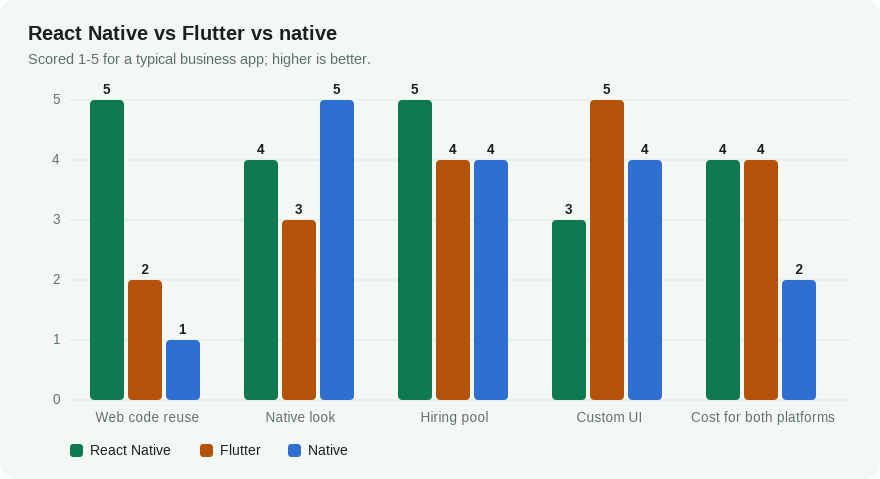
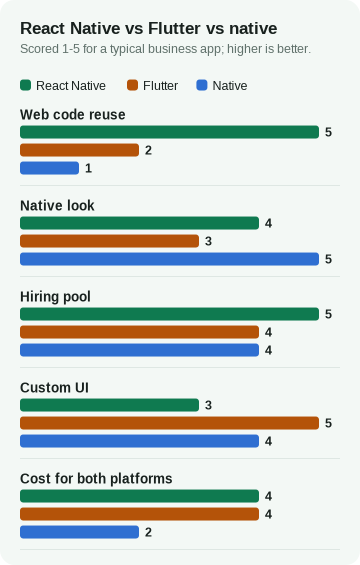
Choose React Native when you have React or TypeScript skills, want to share logic with a web app, or rely on the npm ecosystem. Choose Flutter for highly custom, identical UI; choose native for graphics-heavy or hardware-intensive apps. The full comparison is on our cross-platform app development page. React Native vs React JS comes down to the rendering target: React JS draws to the browser, while React Native draws native iOS and Android components, so what carries over is the language, hooks and business logic.
| Detail | |
|---|---|
| Maintainer | Meta and the open-source community |
| Language | JavaScript / TypeScript |
| Rendering | Native platform components |
| Tooling | Expo, React Native CLI |
| Best for | Business, commerce and SaaS companion apps |
| Watch-outs | Keep versions and dependencies current |
Our React Native development services
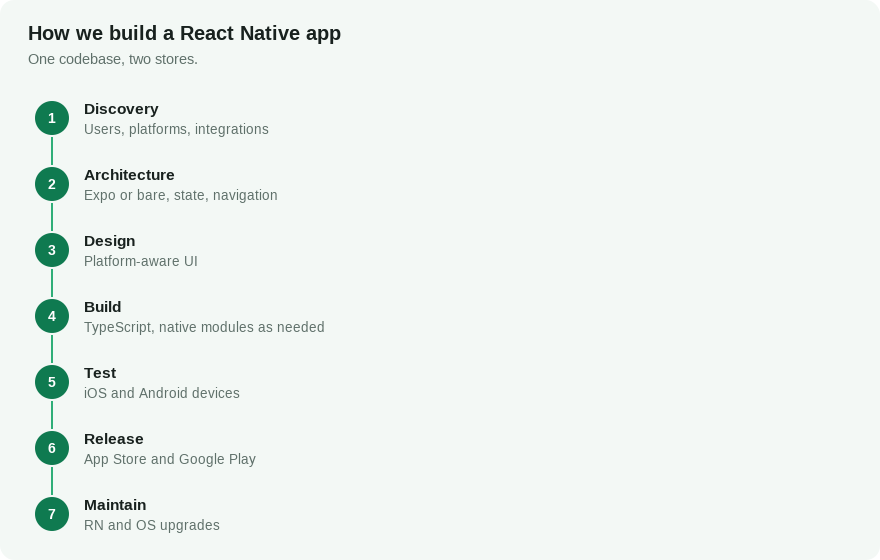
New React Native apps
Full apps from discovery to both stores, with backend and admin. Our React Native app developers also write the native modules a plugin cannot cover, in Swift and Kotlin.
Expo and bare workflows
We use Expo for faster builds and over-the-air updates where it fits, and a bare workflow when custom native code demands it. What is Expo in React Native? The React Native documentation describes Expo as a production-grade framework with tooling such as file-based routing and a standard library of native modules, and it recommends starting new apps with a framework. Your React Native development environment then needs little beyond Node.js and a phone or simulator; the official setup guide walks through it.
Native modules
Swift and Kotlin modules for camera pipelines, Bluetooth, payments and platform features React Native does not cover out of the box.
Upgrades and rescue
Stale React Native projects accumulate breaking changes. We upgrade versions, replace abandoned libraries and restore reliable builds. A reliable build on a supported version is the first job for any React Native software development company taking over an app, since new features land badly on a project that will not compile.
Migrating native apps to React Native
Two native codebases can be consolidated screen by screen into React Native to cut maintenance cost. A React Native application development company can also add new screens inside the existing Swift or Kotlin app one flow at a time, so the store listing, ratings and installed users carry through the move.
React Native dashboard apps for field and operations teams
Managers and field staff who check figures on a phone get little from a shrunken web dashboard. Packaged reporting tools can stop fitting once you need offline data, role-based views or alerts tied to your own systems. React Native software written for that job gives you those pieces in code you own, with charts and lists that respond like the rest of the phone.
What should be ready before we build an app with React Native?
Three things: store accounts in your company’s name, a list of the device features the app needs, and access to the data it will show. With those in hand, design and code can start in the first week instead of waiting on paperwork.
Store accounts take the longest. Apple asks an organization enrolling in its developer program for a D-U-N-S Number, so check whether your company already has one before kickoff. On Google Play, a personal developer account created after November 13, 2023 needs 12 or more opted-in testers in a closed test for 14 days before production access opens, so the listing is best opened as an organization account owned by your company.
The feature list decides the shape of the work when building an app with React Native. Camera capture, Bluetooth hardware, background location and in-app payments each need a library or a native module, and knowing them up front tells us which ones Expo covers and which need Swift or Kotlin. If an API already feeds your website, the app usually reads from it; if not, the backend and admin are scoped alongside the screens.
How much does React Native app development cost?
At market rates, a React Native MVP commonly costs $40,000-$90,000 and a full business app $90,000-$160,000 for both platforms, typically less than two separate native builds.
| Scope | Typical range | Timeline |
|---|---|---|
| MVP (iOS + Android) | $40,000-$90,000 | 10-16 weeks |
| Business app | $90,000-$160,000 | 4-6 months |
| Upgrade / rescue project | $10,000-$40,000 | 2-6 weeks |
Get a free proposal with your exact price, usually the same business day.
Why choose Progression Agency for React Native?
- TypeScript-first React Native teams with native module experience.
- Honest framework advice: we also build Flutter and native.
- Builds on both stores every sprint.
- App Store and Google Play launch handled.
- You own the code. Headquartered in New York City.
How to compare React Native app development services, agency and company options
Any React Native app development agency should be easy to compare on the same few things, and so should a React Native app development service or a React Native mobile app development company. Ask who writes the code, whether the team has released React Native apps in both app stores, and how they handle native modules when a library falls short. React Native mobile app development services should include release, crash reporting and upgrades after launch. If you are also weighing a native mobile app development company, ask for the trade-offs on cost, speed and device features in writing. A React Native development agency should show shipped apps on both stores; when you compare React Native development agencies, ask who writes the native modules and who maintains the upgrades. A React Native agency should also confirm that the store listings and signing keys stay in your name, so the app can move with you if the relationship ends.
What to test when hiring a React Native developer
Most candidates can build screens; fewer can handle what sits below them. A short paid task shows the difference: ask for a small native module in Swift or Kotlin, or an upgrade of a sample app across one React Native version, and watch how the person works through the errors that follow. Ask which of their apps are live in both stores, then install one on an older Android phone. To hire a React Native app developer through an agency, ask for that same paid task from the named engineer who will write your code, so the test measures the person on your project rather than the portfolio.
Before any work starts, put the repository, the Apple developer account and the Google Play console in your company’s name, so a developer can be replaced without losing the app.
The React Native New Architecture
React Native’s New Architecture became the default in version 0.76. It replaces the old asynchronous bridge with direct, synchronous communication between JavaScript and native code, which improves responsiveness and makes native modules faster to call.
| Component | What it does |
|---|---|
| JSI (JavaScript Interface) | Lets JavaScript hold references to native objects and call them directly |
| Fabric | The new rendering system, supporting concurrent React features |
| TurboModules | Native modules loaded lazily and called without the bridge |
| Codegen | Generates type-safe glue code between JavaScript and native modules |
Details from the React Native architecture documentation. We build new apps on the New Architecture and migrate older apps library by library.
Expo or bare React Native?
The React Native documentation now recommends starting with a framework, and Expo is the most widely used. We choose per project. Expo app development still means testing on real devices, because the framework simplifies builds but cannot tell you how the app behaves on an older phone.
| Factor | Expo | Bare React Native |
|---|---|---|
| Setup and builds | Managed cloud builds with EAS Build | Local Xcode and Android Studio builds |
| Native code | Supported through config plugins and development builds | Full direct control |
| Over-the-air updates | Built in with EAS Update | Requires a third-party service |
| Routing | File-based with Expo Router | Choose a navigation library |
| Best for | Most business and consumer apps | Apps with heavy custom native integrations |
Our default
Most projects start on Expo with development builds, which keeps full native access while removing most build maintenance.
Considering React Native?
Tell us about the app and your web stack. We will confirm whether React Native is the right fit.
Getting found in search
AI, AEO and what is changing
Paid media and lead generation
Websites and design
Choosing and working with an agency
Software and app development
- Mobile app development company
- Software development company
- Software consulting services
- AI consulting services
- UI/UX design services
- .NET development services
- Desktop application development
- Progressive web app development
- AR/VR app development
- Wearable app development
- EHR software development
- Hire dedicated developers
- Software development life cycle
- Web application development
- AI app development
- AI agent development
- AI chatbot development
- AI receptionist development
- AI integration services
- Cross-platform app development
- Flutter app development
- Native app development
- iOS app development
- Android app development
- IoT app development
- MVP development
- SaaS development
- Enterprise app development
- App development outsourcing
- Hire app developers
- App development cost
- How to build an app
- App development tools
- Agile software development
- Custom CRM development
- ERP development
- Web portal development
- Marketplace development
- Dashboard development
- API development
- Backend development services
- Healthcare software development
- Healthcare app development
- Telemedicine app development
- Fintech software development
- Insurance software development
- Logistics software development
- Manufacturing software development
- Real estate software development
- Education software development
- Retail software development
- Ecommerce app development
- Delivery app development
- Restaurant app development
- Fitness app development
- Dating app development
- Taxi app development
- Travel app development
- Social media app development
- Video streaming app development
- App development in NYC
- App development in Dallas
- App development in Los Angeles
- App development in Houston
- App development in Atlanta
- App development in Austin
- App development in Miami
- App development in Chicago
- App development in San Diego
Web development, platforms and hosting
Social, content and brand
By industry and by situation
Want the Progression Method applied to your business? It’s proprietary and reserved for clients. Get a free proposal
Frequently asked questions
What is React Native?
Is React Native good for app development?
What is the difference between React and React Native?
Is React Native native?
React Native or Flutter?
React Native or Swift?
How much does a React Native app cost?
How long does React Native development take?
What is Expo?
Can React Native access the camera and Bluetooth?
Can React Native apps be published to the App Store?
Can you upgrade our old React Native app?
Can React Native share code with our web app?
Does React Native perform well?
Who maintains React Native?
Who owns the code?
Where is Progression Agency located?
How do I hire React Native developers?
What does a React Native developer cost?
Can React Native build web apps too?
What should I look for in a React Native company?
Is React Native mobile app development suitable for complex apps?
Is React Native truly native on iOS and Android?
Can a React Native app builder replace a development team?
Planning an app?We build iPhone and Android apps from one TypeScript codebase on the New Architecture, with Expo builds and OTA updates.
Get a free marketing proposal
Tell us what you are trying to grow and we will come back with a plan, not a pitch deck. Same-day reply on weekdays.