
Updated November 2026 · Written and maintained by the Progression Agency strategy team
We are a public relations agency, and this page is written the way we would want one written for us. It covers what a PR agency actually does week to week, what retainers cost across the market, what is different about public relations agencies in New York, how to read a proposal and a media list, how the work should be measured, and the fairly common situations in which the honest answer is that you should not buy PR at all. That way your budget goes to the right job from day one.
Public Relations from Progression.
Get your exact price in a free proposal, usually the same business day.
Get a free proposalThe short versionA public relations agency earns you coverage you did not pay for. It is bought on a monthly retainer, typically $5,000 to $20,000 for a mid-market firm, and it takes six to twelve months before the result is fair to judge. Nobody, including us, can guarantee a placement in editorial media. If your business has a genuine story, PR is often the highest-credibility channel available. If it does not yet, we start with search and content, a cheaper way to reach the same buyers while the story is still being built.


What is a public relations agency?
A public relations agency is a firm you retain to shape and place your organization’s story in media it does not own or pay for. That last clause is the whole definition. Advertising buys space; public relations earns attention. The currency is a journalist’s judgment that your story is worth their readers’ time, and no amount of money changes that judgment directly. What is a public relations firm? It is a company retained to earn press coverage and manage a client’s reputation. What does a public relations agency do day to day, and what does a PR company do? Both pitch stories, manage relationships with journalists, prepare spokespeople and track coverage. Media relations in public relations is the pitching of journalists; the wider discipline also covers positioning, spokesperson preparation and crisis planning, which is why the two terms are not interchangeable. Local recognition can shape an announcement too, as PR in Orlando shows with the Mayor’s letters and proclamations.
In practice a public relations agency does five things: it works out what about you is genuinely newsworthy, it turns that into messages a company can repeat consistently, it identifies the specific journalists who cover that beat, it pitches them, and it prepares your spokespeople to be useful when someone says yes. Everything else, the reports, the media monitoring, the awards submissions, sits around those five. The inner workings of each step are explained on our page about what a PR firm does day to day, while this page stays with choosing an agency and paying for one.
The short definition of a public relations agency
In short, a public relations agency is a firm you pay a monthly fee to earn your organization coverage and reputation in media it neither owns nor buys. It decides what about you is newsworthy, builds the messages, finds the specific journalists who cover that subject, pitches them, prepares whoever will speak, and reports on what the coverage did. It cannot promise any individual article will appear.
Public relations agency, PR agency, PR firm, publicist: do the words mean different things?
Mostly not. Whatever the label on the door, these firms sell the same service, so compare them on placements and on who staffs the account rather than on what they call themselves. The one word that does carry a distinction is publicist, which usually means an individual working on personal or talent publicity rather than corporate communications. A client hiring one of the publicists in NYC nearly always wants individual representation rather than a company retainer.
| Term | What it usually means | Who uses it |
|---|---|---|
| Public relations agency | Full-service corporate communications | Larger firms, formal proposals |
| PR agency / PR firm | Identical to the above | Everyone, informally |
| Publicist | One person, often talent or personal publicity | Individuals, entertainment, authors |
| Media relations agency | PR narrowed to press outreach only | Firms selling a focused service |
| Communications consultancy | Strategy-led, often less outreach | Corporate and policy work |
| brand PR agency | PR with a consumer and brand-building emphasis | Consumer goods, lifestyle |
| Integrated agency | PR bundled with paid and content | Marketing-led buyers |
Because the terms are largely interchangeable, do not read much into which one a firm chooses. A media relations agency and a brand PR agency may do identical work under different labels. Read the case studies, not the noun.
Public relations consultant or agency: which one to hire
A consultant is one senior person, paid by the project or a smaller monthly fee, who advises and sometimes does the pitching personally. That suits a company with an in-house marketer who needs direction: a launch plan, spokesperson coaching, a second opinion on a sensitive announcement. If you buy public relations consultant services, settle the handoff at the start: the consultant sets the angles and coaches the spokesperson, and someone in-house keeps the media list current and chases every pitch.
The limit is capacity. Steady outreach across several beats, or cover when that one person is away, is what an agency team is for. Before signing with either, ask who will actually contact journalists, how many other accounts that person carries and what happens to your work during their busiest month.
What does a PR agency actually do, week to week?
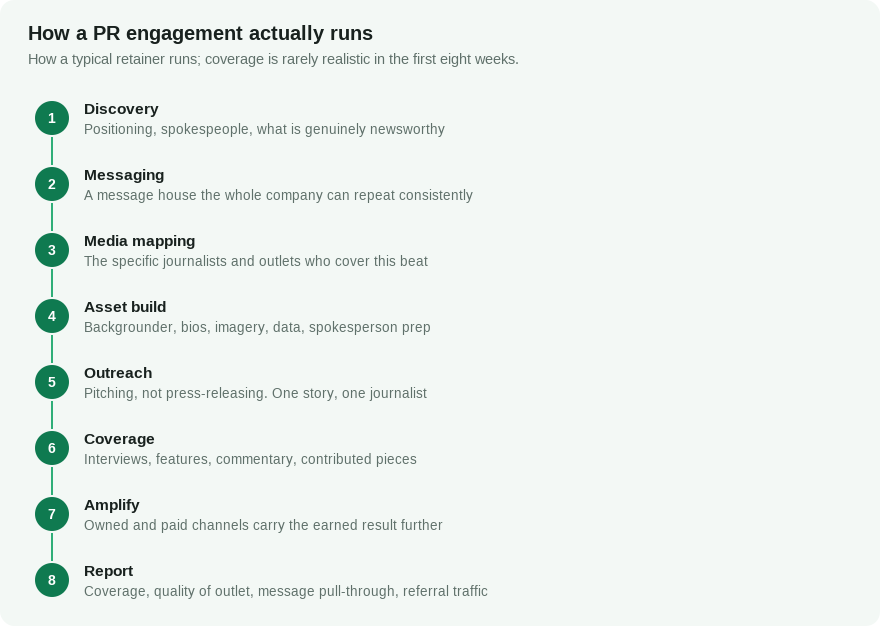
The most common disappointment in public relations is a client who expected output and bought effort. Here is what the effort looks like, honestly described. The job itself, from the first positioning session to the monthly report, is explained step by step in our guide to what a PR firm does. Some of that effort runs on a public calendar; around Milwaukee, a project that needs a village board vote is planned around hearing dates, as PR firms in Milwaukee describe.
Discovery and positioning
Four to six sessions establishing what you do, who cares, and what a journalist could justify writing about it. This is where good agencies earn their fee and where bad ones skip straight to a press release. If nobody asks you hard questions in month one, that is a signal. Public relations plans that come out of these sessions should rank the reporters worth approaching first and say why each one would care.
Media mapping
A named list of journalists, not outlets. “We will target the Wall Street Journal” is not a media list. “Three reporters on the enterprise software beat, one of whom wrote about your competitor in March” is. Ask to see the list before you sign; the specificity of it is the single most predictive thing in a proposal. Radio public relations needs a list of its own, because the person to reach is a booker or producer looking for a guest who can talk, and TV public relations adds the question of whether that guest looks at ease on camera.
Pitching
One story, one journalist, tailored. Mass-distributed press releases still exist and still occasionally work for wire pickup and search visibility, but they are not what a retainer should mostly buy in 2026. Newsroom headcount has fallen for two decades while the number of people pitching has risen; a generic pitch is not merely ineffective, it is invisible. Video public relations can get around part of that problem: a newsroom with a thin crew may use clean footage of a factory floor or a product demo that it could never send someone to shoot. Over a year, media relations in PR comes down to tailored pitches, one journalist at a time: a reporter who got a useful story from you once is more likely to open the next email.
Spokesperson preparation
An interview that goes badly is worse than no interview. Media training, message discipline and rehearsal of the questions you least want to be asked are part of the service, and you should ask explicitly whether they are included or billed separately. Two examples of media relations that need that rehearsal are a background briefing before a launch and a live interview on a reporter’s deadline.
Measurement and reporting
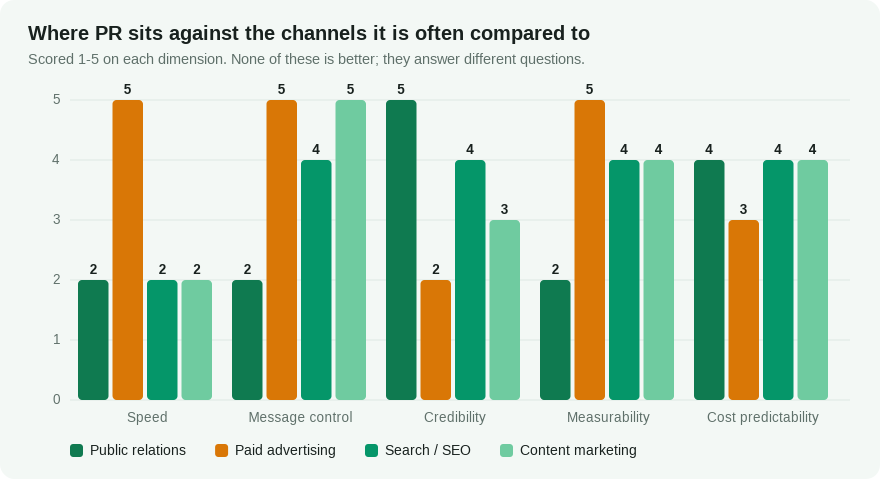
Monthly, and against something you agreed in advance. Coverage volume alone is a vanity number. What matters is the quality of the outlet, whether your actual message survived into the piece, and what the coverage did to search demand and referral traffic for your brand.


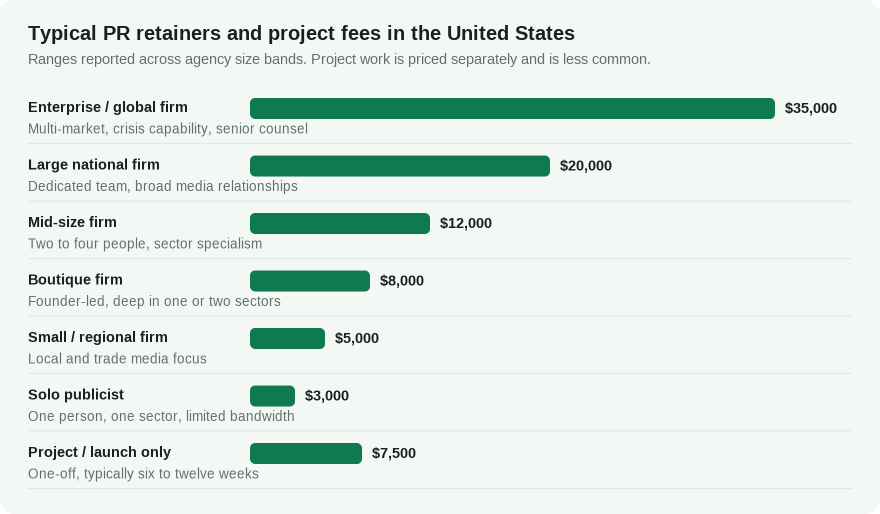
What does a public relations agency cost?
Public relations is sold on retainer almost everywhere, and the retainer buys a defined number of hours from a defined team. The number itself varies more by agency size and market than by the work. When you compare PR agency prices, compare the hours and the named people behind each figure rather than the monthly total alone. When a firm sends a public relations package sample, read it as a menu of activities rather than a promise of coverage, and treat each line as effort bought. A fixed package of media relations services can suit a single announcement, but ongoing pitching needs a named reporter list and a monthly review that packages rarely include.
| Monthly retainer | Team | Realistic scope | Best suited to |
|---|---|---|---|
| $3,000 to $5,000 | One person, part-time | Trade press, one market, reactive | Small firms with a narrow beat |
| $5,000 to $10,000 | Account exec plus part-time senior | Trade plus some national, proactive | Growing B2B and regional consumer |
| $10,000 to $20,000 | Two to four, named | National, sustained program | Funded companies, national brands |
| $20,000 to $35,000 | Dedicated senior team | Multi-market, crisis-ready | Enterprise, regulated sectors |
| $35,000+ | Full team plus specialists | Global, investor, public affairs | Large corporates |
| Project: $5,000 to $15,000 | Varies | Launch or single moment, 6-12 weeks | One-off events with a hard date |


Why hourly and per-placement pricing barely exist
Hourly billing exists but is uncommon, because the work is lumpy and clients dislike unpredictable invoices. Per-placement pricing is rarer still, and where you find it you should look closely: paying per placement creates an incentive to chase low-quality coverage, and in editorial media the agency cannot control the outcome it is being paid for. Where public relations fees and rates are quoted by the hour, ask for a monthly cap as well, so a busy launch month cannot produce an invoice nobody approved.
What is genuinely extra
- Media monitoring software, frequently $200 to $1,500 a month and often passed through at cost.
- Wire distribution, roughly $350 to $1,200 per release depending on reach.
- Awards entry fees, which range from trivial to several thousand dollars each.
- Travel for deskside briefings and events.
- Photography, video and design produced for the campaign.
- Crisis retainers, usually held separately as a standby fee plus an activated day rate.
Get a free proposal with your exact price, usually the same business day.
Public relations agencies in New York: what is actually different
New York holds the densest concentration of national media in the United States, and that is the real reason public relations agencies New York buyers pay a premium. The journalists are here, the broadcast studios are here, and a deskside briefing that requires a flight from anywhere else is a subway ride for a New York team. Other cities bring their own work: in San Diego, manufacturers that build on both sides of the border need every origin claim in a release checked, a job PR firms in San Diego handle line by line. In Boston, a biotech readout can go through seven draft headlines before one runs, as a PR agency in Boston explains. In Cincinnati, Opening Day has its own parade rules a story has to fit, and a public relations firm in Cincinnati plans pitches around them. In San Francisco, one email about a City permit can change who has to register, a line any PR firm in San Francisco has to watch.
Whether that premium is worth paying depends entirely on whether your target publications are national consumer and business media. If they are, proximity genuinely helps. If your audience reads three trade titles whose editors work from Ohio and Berlin, a New York address buys you nothing at all.
| Factor | Hiring a New York firm | Hiring elsewhere |
|---|---|---|
| Access to national media | Strongest in the country | Possible, but relationship-dependent |
| Broadcast and deskside | Same-day, in person | Requires travel budget |
| Typical retainer | 20 to 40% above national median | Lower for equivalent seniority |
| Trade and vertical press | No inherent advantage | Often better if the firm is a specialist |
| Regional and local coverage | Weak fit | Much stronger |
| Time zone for European media | Workable | Depends entirely on location |
How to read “top PR firms NYC” lists
Searches like best PR agencies NYC, top PR firms New York City and best public relations firms NYC return listicles, and it is worth understanding how most of them are assembled. A large share are either paid placements, or aggregated from directories where firms self-report. Very few involve anyone speaking to a client.
We are a New York-area PR agency, and we let audited client outcomes, rather than an invented ranking, guide how you compare firms. What we can give you is a method that works on any list you find, including on the entries that are us.
- Ignore the ordering. Treat the list as a longlist of names, nothing more.
- For each firm, find three pieces of coverage from the last twelve months for clients resembling you. If you cannot, the firm is not a fit regardless of its position.
- Check whether the named team on the website still works there. Agency staff turnover is high and case studies outlive the people who produced them.
- Ask two former clients, not two current ones. Agencies will offer you current clients; ask instead for someone whose retainer ended in the last two years.
- Compare the media list, not the deck. Everything else in a pitch is presentation.


What kind of New York PR firm fits your brief
New York has PR firms of every size and shape, from individual publicists to global network agencies. Knowing which kind fits your brief tells you what kind of shortlist to build, and which lists to ignore.
| Kind of firm | Usually suits | What to expect |
|---|---|---|
| Independent agency | A buyer ready to approach firms directly | Mixed quality, so check recent coverage |
| Larger corporate firm | Corporate rather than consumer work | Formal proposals |
| Established firm with an RFP process | Formal, procurement-led buying | A structured RFP and a longer selection |
| A firm you were referred to | A buyer who has mostly decided | Scope and fees still worth getting in writing |
| Global network agency | Prestige and scale as the filter | Larger teams and larger fees |
| Enterprise-oriented firm | Corporate procurement | Lists and proposals built for enterprise buyers |
| Individual publicist | Talent or personal publicity | One person, not an agency |
| Directory or roundup | Early-stage browsing | Names, not verdicts |
| Ranked listicle | Comparison before contact | Frequently paid placement |
The practical use of that table is this: ranked lists of the best PR companies in NYC are a layer of content built for advertising revenue rather than for you. The sites of public relations firms in New York City, with their recent coverage and client references, are a better place to start reading. A boutique PR agency belongs on the shortlist for a single-sector brief, provided you ask what happens to your account when its two busiest partners are both traveling.
Beyond agencies: related services and narrower purchases
Several adjacent services describe narrower purchases.
- Media relations agencies sell the press-outreach slice of PR without the internal communications, public affairs or investor work. For many smaller buyers this is exactly the right scope.
- Public relations services come first when you are scoping what is available rather than shortlisting a firm: the answer is the workstream table further up this page.
- PR management tends to mean ongoing program management: someone to run the function rather than execute a campaign. Fractional and retained arrangements both cover it.
- PR branding agency and brand PR agency describe PR with a brand-building emphasis rather than announcement-led press work: more feature and profile coverage, fewer releases.
- Public relation sites, meaning industry publications and directories rather than agencies, are where to read up first; PRWeek, Muck Rack and Cision’s resources are the usual places to start.
Public relations agencies near me: does location matter?
A shortlist of PR agencies near me is a fair place to begin, but sector fit predicts a good relationship far better than location, so test every name on it for knowledge of the reporters who cover your industry. For a Miami example of one announcement pitched to an English desk and a Spanish desk, see our PR firms in Miami page.
Public relations companies near me or across the country all work the same way, by email, phone and video. The exceptions where geography genuinely matters are narrow but real: local and regional press coverage, in-person deskside briefings with national media, live broadcast, and any work that requires someone physically present during a crisis. If none of those describe your program, hire the firm that knows your sector, wherever it is. If regional coverage is the goal, ask local PR companies to show which outlets the retainer covers and who on the team has pitched them in the past six months.
Where local really does win
- Local news coverage. Regional outlets are relationship businesses and local firms have those relationships.
- Public affairs and planning. State and municipal work needs people who know the actors.
- Crisis with a physical location. Someone needs to be at the site.
- Event-heavy programs. Launches, press days, and anything with a venue.


How should you brief a global public relations firm?
Give it three things in writing: the markets in priority order, who approves announcements in each country, and who owns the master message. The order matters most, because a firm working across countries staffs what the brief says matters, and a plan naming twelve countries with equal weight tends to get thin outreach in all twelve.
The fee follows that list. Active pitching in a market means someone who reads its press, writes in its language and is at work when its reporters file, so each added market adds hours rather than a translation line. Corporate communications firms quoting cross-border work should also price the review cycle, because results, acquisitions and leadership news often pass legal and investor teams in more than one country before release.
Ownership of the master message is where cross-border work most often slips. On these programs Progression Agency takes the part communications consulting firms usually play: it drafts one approved core narrative, agrees who in each market signs off local edits and how fast, and keeps every country working from that version, so no market drifts toward a story of its own.
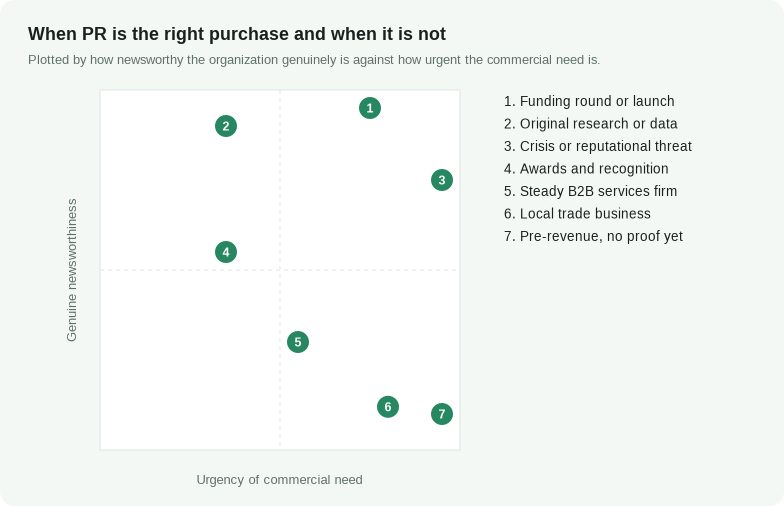
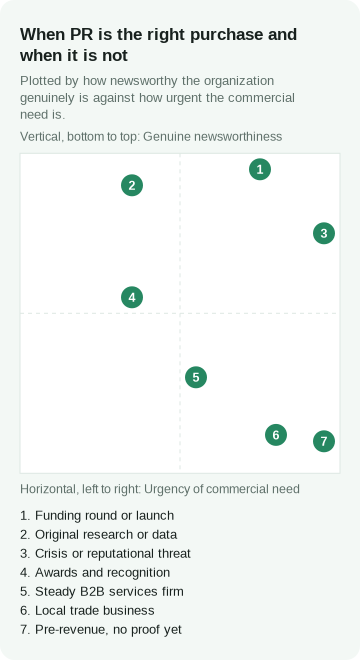
Is PR the right purchase for you at all?
This is the section most agency websites do not have. Public relations is genuinely excellent at some jobs and genuinely poor at others, and buying it for the wrong job is the most expensive mistake in the category.
PR is usually the right call when
- You have a real, checkable story: funding, a launch, original research, an acquisition, a milestone.
- You are entering a category where credibility gates the sale: healthcare, finance, security, legal.
- You are facing a reputational threat and need experienced counsel quickly.
- You have executives who are genuinely good on the record and are willing to spend time on it.
- Your buyers read a small number of identifiable publications you are absent from.
PR is usually the wrong call when
- You need leads this quarter. PR does not work on that timescale and pretending otherwise wastes months.
- You have nothing to say yet. Pre-revenue with no product and no data is not a story.
- Your customers find you through search. A local trade business gets more from reviews and local SEO than from any retainer.
- You cannot free up executive time. PR consumes the time of the people who are hardest to free up.
- You want message control. If the message must be exact, buy advertising instead.
If you are reading this because someone told you that you need PR, it is worth asking them which of the situations above they think you are in. A specific answer is a good sign. A general one about visibility usually is not.


What we do as a public relations agency
We run PR the way the rest of our work runs: a named team, hours written down, measurement agreed before anyone signs anything, and a thirty-day notice period after the first three months. The three months exist because the opening weeks are set-up with nothing visible to show for them, and we would rather say that plainly than have you wonder in week five.
| Workstream | What it covers | Who does it |
|---|---|---|
| Positioning and message house | What is genuinely newsworthy about you, in language your whole company can repeat | Senior strategist |
| Media mapping | A named list of journalists on your beat, refreshed monthly | Account lead |
| Proactive pitching | Tailored, one story to one journalist, not mass distribution | Account lead and exec |
| Reactive and commentary | Journalist requests, expert commentary, rapid response | Account exec |
| Spokesperson preparation | Message discipline and rehearsal, including hostile questions | Senior strategist |
| Contributed and thought leadership | Bylines, opinion pieces, original data write-ups | Writer plus account lead |
| Measurement | Share of voice, message pull-through, branded search, referral | Analyst |
| Search integration | Landing pages and entity work so coverage has somewhere to land | SEO team |
What a PR engagement covers
- Reporting covers message pull-through, share of voice and branded search in place of Advertising Value Equivalent, and we will talk through why if you ask for it.
- Briefs start once there is a story, and we tell you what would make one.
- Engagements run month to month.
- Every pitch goes to a journalist whose work we have read.
- Each placement is reported with its outlet and date.


How we price it: our actual retainers, published
Our PR retainers are $3,000, $5,400, $9,000 and $14,500+ a month, plus project work from $4,800. We publish them because this page spends two thousand words arguing that PR pricing is needlessly opaque, and it would be incoherent to then hide our own.
| Our retainer | Hours a month | Who does the work | What it realistically achieves | Right for |
|---|---|---|---|---|
| $3,000 | Approx. 15 | One senior practitioner, part-time | Trade press in one vertical, reactive commentary, one owned narrative | A single clear story and a narrow beat |
| $5,400 | Approx. 28 | Senior lead plus support | Trade plus regional, proactive pitching, two or three angles in rotation | B2B firms and regional consumer brands |
| $9,000 | Approx. 48 | Named two-person team | Sustained national pitching, spokesperson program, awards and speaking | Funded companies and national ambitions |
| $14,500+ | Approx. 75 | Named team plus specialist input | Multi-market, sustained, crisis-ready with a standby clause | Enterprise and regulated sectors |
| Project from $4,800 | Scoped | Varies by brief | A launch, a funding round, a single moment over 6-12 weeks | One-off events with a hard date |
Read the hours column rather than the price column. That is the honest comparison, and it is the one almost nobody publishes: a $7,500 retainer buying forty-eight hours from named people is a very different purchase from a $7,500 retainer buying twenty hours from whoever is free. Ask any agency you are considering for the same two numbers.


How our retainers handle placements and fees
- Paid placement of any kind. If a payment secures coverage it is advertising, and it gets labeled as advertising.
- Wire distribution fees. Billed at cost when a release genuinely needs one, which is less often than the industry implies.
- Awards entry fees and event costs. At cost, with our recommendation on which are worth entering.
- Media training beyond a first briefing, which is quoted separately.
- Crisis activation. Held as a standby clause on the $12,000 band and quoted as a day rate when activated, because pretending a crisis fits inside a normal month is how retainers get quietly consumed.
- Long lock-ins. Thirty days notice. Our terms run month to month, which means we keep earning it.
Updated August 2026. These are our own published retainers, not market averages. The market bands earlier on this page are a separate thing, a guide to what other agencies charge, and they are labeled as such. Our numbers sit below the national mid-market median with the full scope behind them, and the hours column is there so you can check that for yourself.
Where PR sits alongside the rest of what we do
Most of our PR clients also buy search or content work from us, and that is not an upsell: it is the reason the PR performs. A coverage moment with no page to receive the traffic wastes most of its value, and a page written without knowing what the coverage will say misses the terms people actually search afterwards. If you would rather keep the two separate, that is fine; we will just insist the two briefs are written in the same room.


How to judge a PR agency proposal
The questions that actually separate firms
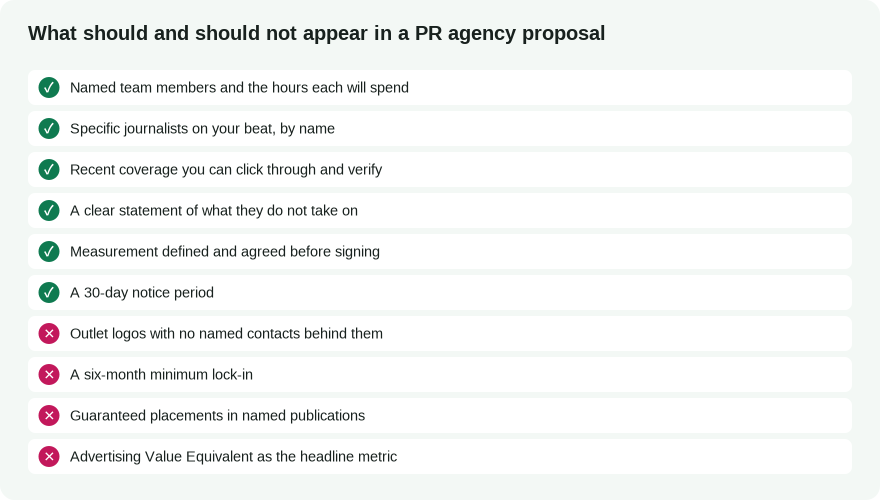
- Who will do the work day to day, and how many hours a month does the retainer represent for each of them?
- Show me the media list for my brief, named journalists, not outlets.
- What coverage did you secure in the last six months for a client of my size in my sector?
- What kind of brief do you turn down?
- How will we define success, and when is it fair to judge this?
- What is the notice period, and what happens to the work in progress if we leave?
- Who owns the media relationships and the contact list at the end?
Red flags, in order of seriousness
- Guaranteed placements. In editorial media, this means either paid content described dishonestly, or a promise the agency cannot keep.
- Advertising Value Equivalent as the headline metric. AVE prices coverage as though it were advertising, which it is not. Most professional bodies have discouraged it for years.
- A long minimum term. Six and twelve month lock-ins protect the agency, not you. Thirty days’ notice after an initial three-month period is a fair structure.
- A media list made of logos. Outlet logos are not access.
- No questions about your business. A firm that can pitch you without understanding you will pitch journalists the same way.


Terms to settle before a PR retainer starts
The proposal tells you who does the work; the contract should also settle what happens in an ordinary week. Agree who on your side approves a pitch or a quote and how quickly, because a story that waits three days for sign-off has usually moved on. Decide whether hours the agency does not use in a quiet month roll over or lapse. And list any outlets that are off limits, such as a trade title you advertise in or a reporter you are in a dispute with, so nobody finds out after the pitch has gone. Write down when public relations rates can be reviewed, usually at renewal, and how much notice an increase needs, so a price change never lands in the middle of a campaign.
How can you test media relations firms before a retainer?
Ask each one for a sample pitch and a single project. A pitch drafted for your actual news and addressed to a named reporter shows a firm’s judgment better than any credentials deck, and one announcement run as a project shows how it works against a deadline.
Judge the sample on two points: whether it names a reporter who has covered your category lately and refers to that work, and whether it asks for something concrete, such as an interview, a dataset or an embargoed briefing. A media relations PR agency that knows your beat can write that from a short brief, and the draft shows whether it understood the story.
For the project itself, agree the target list and what the report will show before outreach starts, including how declines are logged. The reasons reporters give for passing are the most useful thing a first story produces, since they show how to shape the next one. Progression Agency takes single announcements as project work, so a first story can run before any retainer is signed.
What makes the best PR firm for your company
Fit and attention, more than fame. The best PR firm for a regional law practice may be a two-person shop with strong ties to the local business press, while a public company needs a team that can handle investor scrutiny and a crisis at short notice. A firm many would call the best PR agency in the world can still be the wrong hire for that law practice if nobody on its team reads the regional business pages.
Retainer size matters too: a small account at a large agency often gets junior staff, and a large account at a small firm can swallow its entire capacity. Before signing, insist on meeting whoever will do the pitching, ask how much of the fee pays for their time, and ask which outlets they would approach first for a company like yours. The best publicity agency for a launch is one with relationships in the beat where the launch will be covered; steady reputation work calls for a different fit.
How PR is measured, and how it should be
Measurement is the weakest part of the discipline and the part most worth getting right before you sign, because after the fact everyone measures whatever flatters the result.
| Metric | What it measures | Worth using? |
|---|---|---|
| Share of voice vs. named competitors | Relative presence in your category | Yes: the best single number |
| Message pull-through | Whether your actual point survived into the piece | Yes: quality, not volume |
| Quality-weighted coverage | Coverage scored by outlet relevance and reach | Yes |
| Branded search volume | Whether coverage created demand | Yes: and independently checkable |
| Referral traffic and assisted conversions | Commercial effect | Yes, with attribution caveats |
| Coverage volume | How many pieces appeared | Weak on its own |
| Impressions / potential reach | Theoretical audience of the outlet | Weak: wildly overstated |
| Advertising Value Equivalent | Cost of buying the same space as ads | No: discredited |
The two measures we would insist on if we were buying PR are share of voice against named competitors and branded search volume, because both are checkable without the agency’s cooperation. You can watch branded search demand yourself in Google Search Console and Google Trends, which makes it difficult to spin. Press public relations rarely ties neatly to revenue, which is why both measures are worth setting up before the first pitch goes out.


Public relations and search: how the two actually interact
This is the part we can speak to with authority, because it is our own discipline. Coverage affects search in three specific ways, and understanding them changes how you brief a PR agency.
- Links. Some coverage carries a link and some does not. Links from high-authority news domains are among the most valuable in organic search, but many major outlets now apply nofollow by default. Ask, but do not brief for links: a journalist who is asked for a link often removes the mention entirely.
- Branded demand. Coverage makes people search for you by name. Branded search is the cleanest evidence that PR worked, and it is visible in Search Console within days.
- Entity signals. Consistent, corroborated mentions across credible sources help search engines and AI answer systems establish who you are and what you are known for. This is increasingly how generative engines decide who to cite.
The practical consequence: PR and search work should be briefed together. A coverage moment with no landing page to receive the traffic wastes most of its value, and a page built without knowing what the coverage will say misses the terms people will actually search.
Crisis communications: the specialism worth paying for separately
Crisis work is a different discipline that happens to sit inside the same industry. It is bought differently, usually as a standby retainer plus an activated day rate, and the firms who are genuinely good at it are not always the firms who are good at launches.
- Agree a crisis protocol before you need one: who speaks, who approves, how fast.
- Keep holding statements drafted for the three most likely scenarios in your sector.
- Establish a single source of truth internally. Most crises are worsened by contradictory statements.
- Never speculate on cause. “We are investigating and will share what we find” survives scrutiny; a guess does not.
- Brief staff before the press. Employees leak, and they leak faster when they feel uninformed.
Watching the industry talk about itself
Public relations is unusually well documented by the people who work in it. These are publicly available talks and interviews from Muck Rack, Cision, PRWeek and Harvard Business Review on journalist relationships, pitching, crisis planning, measurement and how AI is changing the workflow. None of them are ours; each links to its original channel and is credited by name. Tiles load the player only when you click. If you are about to brief an agency, the measurement and pitching talks will tell you which questions are worth asking.
The history that explains how agencies work now
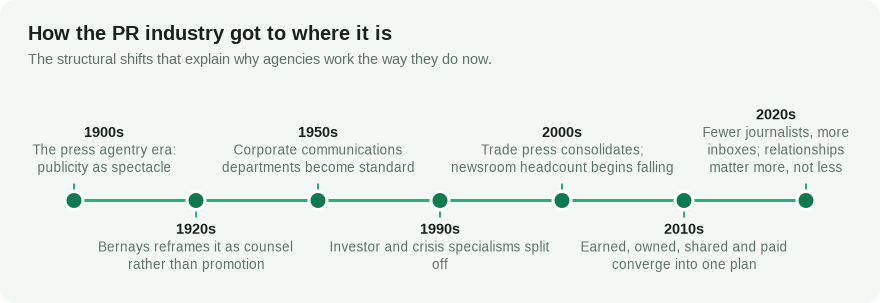

The single most consequential fact for anyone buying PR today is newsroom contraction. There are far fewer working journalists than there were twenty years ago, and each of them covers more ground. That has not made PR less effective: it has made the relationship-driven part of it more important and the volume-driven part of it worthless. Even the best PR companies in the world now win coverage through fewer, deeper ties with the reporters who remain, so a shortlist should test which journalists on your beat each firm has worked with over the past year.
Top PR firms technology: what specialization actually buys you
Journalist relationships in your specific beat, and language fluency. The top PR firms technology companies use are not better at public relations in the abstract; they are better because they already know which reporters cover your category and can describe your product without a translation layer. Both save months. The same is true of entertainment, where an entertainment PR agency already knows the trade press and the release calendar. A PR agency technology buyers hire should know the beat, a tech public relations agency adds product and funding announcements to the mix, a PR agency for tech companies should show coverage in trade titles, and a cyber security PR agency needs to explain threats accurately without hype. PR for actors follows the same logic, because the work is timing coverage to a project’s release and knowing which trade outlets cover it.
The cost of that specialization is conflict risk and premium pricing. A firm deep in your category may already represent an adjacent competitor, and specialist rates run above generalist ones. Ask the conflict question in the first meeting rather than the third. Conflict checks matter most with the top PR agencies in the US, because a firm holding many accounts in one category is more likely to represent a close competitor of yours.
When a generalist is the better choice
When your audience is not primarily trade press: consumer technology, local business technology, anything sold to non-specialists. A generalist with strong consumer relationships reaches those readers better than a deep enterprise specialist will.
Corporate communications: the function next to public relations
A corporate communications agency handles how an organization speaks about itself as an organization, to employees, investors, regulators and the public, rather than how it promotes products. Corporate PR overlaps heavily with it, and a corporate comms agency is usually the right hire when the subject is the company rather than what it sells. A communications marketing agency sits on the other side of that line, carrying launches and campaigns, so it fits when what you need to say is about what you sell. A brand communications agency works across that line, keeping the voice, claims and visual identity consistent whether the message is a product launch or a statement from the chief executive.
The distinction matters at the point of briefing. A product launch is marketing communications; a restructuring, a leadership change, an acquisition or a regulatory issue is corporate communications, and the skills and the review process differ. A corporate communication agency that has done the second will ask about internal audiences in the first meeting. Internal comms agencies are the narrower choice when the audience is employees alone, as with a policy change or a reorganization. Progression Agency runs public relations and communications for both kinds of subject, so a product launch and a leadership announcement in the same quarter sit on one calendar.
When you need a corporate communications agency rather than a PR firm
- Anything affecting employees before it affects customers.
- Investor and analyst communication around results or structure.
- Regulatory or legal matters where wording carries consequence.
- Leadership transitions and succession.
- Crisis response, where the audience is everybody at once.
- Positioning the organization itself rather than a product.
What is a byline, and why do bylines matter in PR?
A byline is the line naming the author of a piece: the byline meaning in practice is simply who wrote it. In public relations the byline definition extends to a specific tactic: a bylined article is one written by or attributed to an executive and published under their name in a relevant outlet.
Understanding what is the byline on a piece matters because bylined articles are among the most useful earned-media formats available. They carry your executive’s name and view rather than a journalist’s interpretation, they demonstrate expertise directly, and they are frequently easier to place in trade publications than a news story is. Thought leadership PR built on bylines also needs a steady supply of views, so plan one strong opinion per quarter from the executive rather than a monthly article stretched thin.
What are bylines in media relations, and how are they placed?
Bylines meaning in the media-relations sense are contributed articles: you pitch an idea to an editor, they accept or decline it, and if accepted you write it to their brief. Payment does not change hands in either direction; if it does, the piece is sponsored content and must be labeled as such.
What makes a bylined pitch succeed
- An idea, not a topic. Editors accept arguments, not subject areas.
- Relevance to that publication’s specific readership, demonstrated.
- A named author with genuine standing to make the argument.
- No product promotion, which is the fastest route to rejection.
- A stated word count and a deliverable date.
- Willingness to be edited, including having the conclusion softened.
How to write a media pitch
Short, specific to that journalist, and leading with the story rather than the company. A media pitch example that works is three sentences: what happened or what you are arguing, why it matters to their readers now, and what you can provide: access, data, an interview.
Almost every failing pitch fails the same way: it describes a company rather than a story, it goes to a list rather than a person, and it buries the point below three paragraphs of context. A sample media pitch that succeeds could be read in fifteen seconds and answered with a yes or a no. A press stunt is a pitch with a bigger production bill, so show the idea to one trusted reporter before you spend money building it.
The structure that works
- A subject line stating the story, not your company name.
- One sentence saying what is new or what you are arguing.
- One sentence on why it matters to that publication’s readers.
- One sentence on what you can provide: data, access, an interview, images.
- Your name, your number, and nothing else.
- No attachments unless asked, because they trigger filters.
Public relations case study material
A case study for public relations is a written account of what you set out to do, what you did and what resulted. The credible ones state the objective in advance, describe the constraint, and report the outcome including where it fell short. The unconvincing ones list coverage without ever stating what success was supposed to look like.
What a media publicist handles
The week goes to a few repeated tasks: building a short list of reporters who fit the client, pitching each one a specific angle, booking interviews and preparing the client for them. What the publicist cannot control is whether the story runs, which stays with the outlet. The odds improve with timing: hire a publicist a few months before the release, show or launch, because reporters and producers plan coverage well ahead of the date.
A talent agent finds and negotiates paid work, while the publicist works on the coverage that makes that work easier to find. People with a book, a release or a project to promote often need both, and each should know what the other is doing.
What an Atlanta publicist handles for talent and productions
Georgia’s film and television work means many Atlanta projects center on a shoot, a premiere or a series announcement rather than a product launch. A publicist on that kind of project times coverage to dates the studio or network controls, clears quotes and photos with the production before they go out, and works inside the embargoes a distributor sets. Find out early who approves press on the production side, because that answer shapes the whole calendar. A company with a case at the federal courthouse in Atlanta needs a different plan; see our page on public relations firms in Atlanta.
Public relations and politics
Political communications is a distinct specialism with its own rules and its own risks. PR and politics overlap in technique and differ substantially in regulation, particularly around disclosure, funding and lobbying, which vary by jurisdiction and carry legal consequence. Washington work, where foreign agent and lobbying disclosure rules sit beside the pitch, has its own page on PR firms in Washington DC. Public communications work for a government body or a campaign carries those disclosure rules, so confirm what applies in your jurisdiction before signing anything.
For a commercial organization the practical points are narrower: understand that any political association attaches to your brand for longer than the campaign lasts, that employees and customers may not share the position, and that politics PR is one of the few areas where the downside is genuinely asymmetric. Take specialist advice rather than treating it as ordinary communications work.
What a strategic communication strategy should contain
The plan starts from one business goal and works backward: who has to change what they believe or do, which message would move them, and which channels and spokespeople reach them. Public relations planning adds a calendar to that chain: product news, results, seasonal hooks and industry events, each one a reason a reporter could give an editor for covering the story this week.
The part of the plan aimed at reporters is strategic public relations, so the message is tested against what a journalist could justify writing. For a company-level subject such as a merger, strategic corporate communications also covers employees, investors and regulators, each on a different timeline. Write the plan on one page: goal, audiences, message, channels, owner and how you will measure it. Revisit PR plans every quarter, because launches, spokespeople and the news calendar change faster than the business goal behind them.
When a public relations marketing agency should run both
Journalists, podcasts and other people’s channels are where press work gets attention, while marketing buys or builds its own: search, ads, email and the website. The two feed each other. A news mention gives paid ads something credible to point to, and search content gives a journalist something to cite. One firm running both removes the hand-off, so the message, dates and reporting sit in one plan. A specialist press shop works one sector, while a combined program carries the same story across press and paid channels. Choose by where your gap is: press first if the product is proven but unknown, marketing first if people know you but do not convert. Whichever comes first, a PR marketing company should name in its proposal how coverage gets reused: which placements become ad creative, which quotes go on landing pages, and who adds new coverage to the site.
Where your team helps
Progression runs public relations across trade and vertical media where reporters are accessible, and extends that reach wherever competition for attention runs higher, working with any in-house marketer you have.
- Build a list of twenty journalists who cover your sector. Read what they have written for a month before contacting any of them.
- Write one genuinely useful piece of original data: a survey of your customers, an analysis of your own anonymised numbers. Original data is the most reliably pitchable thing a small company owns.
- Pitch one journalist at a time, in three sentences, with the story in the first one.
- Say yes to every reasonable interview request for a year, including small podcasts.
- Sign up for a journalist request service and answer promptly and specifically.
- Publish the data on your own site as well, so the coverage has somewhere to point.
If that produces nothing after six months of honest effort, you have learned something useful about whether your story is a story, and it will have cost you far less than finding out on a retainer.
Tell us what you are trying to make people say about you
Send the story you think you have, the outlets you want to be in, and a budget range. You will get an honest read on whether it is newsworthy, a named media list for your beat, and a scope with the hours written down. If we think search or content would get you further this year than a PR retainer, we will say so: we sell those too, so nobody here is arguing against their own interest.
Do you actually need a PR agency near you?
Usually not. What a business really wants from PR companies near me, or from public relations firms near me, is accountability rather than proximity, and the thing that actually predicts a good relationship is whether the firm knows the journalists who cover your sector, which is a beat question, not a geography question.
| Situation | Does local matter? | Why |
|---|---|---|
| Local or regional press is your target | Yes | Relationships are built in the market |
| Trade press in a national industry | No | The beat is national, wherever they sit |
| Crisis response | Partly | Speed matters; time zone matters more than distance |
| Media training | Yes, for in-person sessions | Remote works, in-person works better |
| Events and launches | Yes | Somebody has to be in the room |
| National consumer campaign | No | Reach is not built from an address |
| Analyst relations | No | Analysts are distributed anyway |
Time zone beats distance
A firm three hours behind you cannot answer a journalist working to a morning deadline in your market. That is a far more practical constraint than mileage, and it is the one people forget to ask about.
What to ask instead of where a firm is based
Ask every firm on your list, local or national, three things: which journalists on our beat do you know by name, what have you placed in the last quarter in our sector, and who will be on the account daily. Those three questions predict outcomes; a ZIP code does not.
Getting found in search
- Ranktracker review
- Nightwatch review
- SEO company in Dallas
- SEO company in Oakland
- SEO company in Denver
- SEO company in Houston
- SEO company in Charlotte
- SEO companies by city
- Web design companies by city
- SEO company in Hawaii
- SEO for HVAC services
- Statewide SEO services
- Small business SEO
- SEO experts
- SEO pros and cons
- What is corporate SEO?
- Does URL length affect SEO?
- Meta description length
- SEO services
- SEO agency
- What are SEO services?
- What is SEO?
- Buyer personas
- Retail market research
- Local SEO services
- Local search
- Claiming a business profile
- Local SEO vs national SEO
- SEO company in New Jersey
- SEO agency NYC
- Affordable SEO services
- Best SEO company for small business
- SEO audit service
- SEO packages and pricing
- SEO pricing guide
- How long does SEO take?
- How to rank higher on Google
- Website not showing up on Google
- Google Business Profile not showing up
- How to set up a Google Business Profile
- Why is my website not getting traffic?
- SEO content writing service
- Shopify SEO services
- How to get more Google reviews
AI, AEO and what is changing
Paid media and lead generation
- Social media advertising
- What batch work is
- Free tools for service businesses
- What digital presence is
- Website visitor tracking
- Email marketing examples
- Fear-based advertising
- The annual business review
- Twitter alternatives
- Lead generation agency
- Contractor lead generation
- Solar leads
- What is lead generation?
- What is a funnel in marketing?
- Cost per lead benchmarks
- Performance marketing agency
- What is appointment setting?
- Search ad conversion rate trends
- PPC agency
- HVAC leads
- Social media marketing pricing
- Digital advertising agency
- Media buying vs media planning
- Choosing a marketing company
- CRM software examples
- Global marketing companies
- Buc-ee’s marketing analyzed
- Product launch ideas
- Hulu and streaming advertising
- Advertising agency in Houston
- Dentist PPC
- Facebook ads agency
- Meta Business Partners
- Google Ads management agency, San Francisco
- Shopify PPC agency
- Roofing Google Ads agency
- Digital ads 101
- Meta ad specs
- Estimating landscaping jobs
- WordPress developers Los Angeles
- Digital marketing agency San Jose
- Google Business Profile posts
- Humor in advertising
- Competitors bidding on your brand
Websites and design
- Web design in Queens
- Web design for small business
- Shopify agency
- Shopify checkout optimization
- Headless commerce and Hydrogen
- Shopify pricing guide
- Shopify checkout extensibility
- Squarespace pricing
- Publishing a Squarespace site
- What Squarespace is
- Learning Squarespace
- Squarespace dropdown menus
- Domain vs website
- Videography websites
- Ecommerce product configurators
- Negative space in design
- YouTube channels for web designers
- How to back up a Squarespace website
- Best dental websites
- Website dimensions and image sizes
- Web design in Charlotte NC
- Web design in Nashville
- Web design in Seattle
- Web design in Atlanta
- Retail consulting
- Product design agencies
- Digital product agencies
- Hire PHP developers
- Bankruptcy lawyer website design
- Web design in North Carolina
- Web design in Seattle
- Ecommerce web development
- Ecommerce development services
- Squarespace customization
- Consulting websites
- Beauty stores on Shopify
- Content commerce
- 404 and bad request errors
- FTP clients
- Website design and development
- Design, development and management
- Creating a gallery
- Custom CSS
- Summary blocks
Choosing and working with an agency
- Digital marketing agency in New Jersey
- Fractional CMO services
- What is a fractional CMO?
- About Progression Agency
- Startup marketing agency
- Marketing agency in Tampa
- Marketing agency in San Diego
- Digital marketing in Florida
- Marketing agency in Nashville
- Marketing agency in Portland
- Client testimonials
- Contact us
- Marketing agency near me
- Online reputation case studies
- Digital marketing agency, Dallas
- Orlando digital marketing agency
- Advertising agencies in Westchester
- Water damage restoration leads
- General contracting leads
- Home inspection leads
- Spray foam insulation leads
- Mold remediation leads
- Digital marketing agency in Toronto
- Digital marketing internships
- Marketing consulting firms
- Marketing agency in Austin
- Advertising agency, Columbus
- Advertising agency, Charlotte
- Digital transformation consulting
- Ethos in advertising
- Sales promotion examples
- Experiential marketing agency
- Marketing strategy
- Small business marketing
- Brand awareness for professional services
- Healthcare strategy consulting
- Digital healthcare marketing
- Marketing agencies in NYC
- Digital marketing agency NYC
- Digital marketing in Atlanta
- Digital marketing in Connecticut
- Digital marketing in Oklahoma City
- Nonprofit marketing agency
- Pharmaceutical marketing agency
Social, content and brand
- Create a LinkedIn business page
- Editing Instagram Reels after posting
- Reordering Instagram highlights
- Trending Reels audio
- TikTok trends this week
- Instagram active times
- Instagram posting guide
- TikTok video length
- Instagram Reel length
- TikTok pay per view
- YouTube pay per view
- Why people use social media
- Buffer review
- Social media agency in Denver
- Social media agency in Chicago
- Publicity vs public relations
- Specialist PR agencies
- PR for startups
- PR firms in Pittsburgh
- Influencer marketing guide
- Reputation management in NYC
- Brand advertising case studies
- Logo design in New Jersey
- Documentary interview questions
- Video production in Washington DC
- Video production in Jacksonville
- Video production in West Palm Beach
- Wellness photography
- Public domain image sites
- Social media marketing
- Manufacturing social media marketing
- Social media marketing tips
- Managing a business social account
- Social media and marketing trends
- Social media food marketing
- Influencer marketing agency
- Video marketing agency
- Creative agency
- What branding costs
- What color represents strength
- Branding agency
- Graphic design
- Choosing a color palette
- Medical logo design
- Hospitality branding agency
- Can a brand own a color?
- Iconography definition
- Storytelling in marketing
- Brand consistency for small business
- Life coach website design
- Insurance branding agency
- Advertising mascots
- Event marketing agency
- Email marketing service
- The Progression blog
- Video production company NYC
- What does a video production company do?
- Video production near me
- How to make a film
- Micro-documentaries
- LED volume walls
- LED video wall rental
- AV companies, Washington DC
- Grip and electric
- Documentary filmmaking
- Post-production
- Production technology
- Real estate videography
- Film production in Florida
- Finding a web design studio
- Growing a painting business
- Business vlogs
- Social media trends this week
- B2B social media agency
- Automotive social media marketing
- Saving Instagram Stories as drafts
- What is guerrilla marketing?
- Video production services
- How green screen works
- Social media management fees
- Outsourcing social media
- Film production companies
- What video production costs
- Corporate video production
- Adding music to a Canva video
- Video production in Tampa
- PR agency in NYC
- Crisis management PR
- What is a backgrounder?
- PR firms in Austin
- Public relations in Dallas
- PR firms in Chicago
- Beauty PR agency
- Event PR firms
- PR firm services
- Crisis communications
- Media training, New York
- Healthcare PR questions
- Nonprofit public relations
- B2B PR agencies
- PR for venture-backed startups
- Proactive and reactive outreach
- Sports PR and athlete branding
- Mobile app PR agency
- Arts and culture PR
- Lifestyle PR
- Executive brand building
By industry and by situation
- B2B SaaS marketing agency
- Cybersecurity marketing agency
- B2B intent data providers
- Marketing for home builders
- How to start a landscaping business
- Oregon business licensing
- Landscaping contract template
- Attracting high-income clients
- Human Design coaching explained
- Minneapolis marketing agency
- Web design San Antonio
- Telecom marketing agency
- Starting a graphic design business
- Sales personality types
- Retail competitive analysis
- What is product mix?
- What is BNI?
- When your market shifts
- Virtual conference best practices
- Landscaping profit margins
- Landscaping business structure
- Landscaping marketing
- Pest control marketing
- Nonprofit marketing
- How to get more customers
- Marketing ideas for small business
- Marketing plan template
- Roofing marketing agency
- Marketing agency for contractors
- Landscaping marketing agency
- Auto dealer marketing agency
- Med spa marketing agency
- Chiropractic marketing agency
- Marketing agency for accountants
- Restaurant marketing agency
- Tech marketing agency
- Real estate marketing agency
- Medical marketing agency
- SEO agency Los Angeles
- SEO company in Seattle
- Kitchen remodeling marketing
- Bathroom remodeling marketing
- Bathroom remodeling leads
Full service, consumer, corporate, PR-and-marketing: what the labels actually mean
They describe scope, not quality, and only two of them narrow anything real. A full service PR agency covers media relations plus content, digital and often crisis; a consumer public relations agency specializes in the press that reaches shoppers rather than buyers. The rest are marketing positioning. A creative public relations agency leads with ideas that earn attention, and a marketing PR agency ties coverage to campaigns and sales. A boutique public relations firm sits at the other end of that range: a small senior team, often in one sector, that takes fewer clients and staffs each account with the people who won it.
| Topic | Genuinely narrows | Carries no signal about |
|---|---|---|
| Full service PR agency | Scope: media relations plus content, digital and usually crisis | Size, sector depth or seniority |
| Consumer public relations agency | Consumer press rather than trade or B2B titles | Whether they also do corporate work |
| PR and marketing company, or a PR and comms agency | Both disciplines under one roof | Which half they are actually good at |
| PR ad agency, offering earned and paid media together | Earned and paid together | Whether media buying is real or subcontracted |
| Public relations firm services | A service list rather than a shortlist | Anything about capability |
The row worth acting on is the third. An agency offering PR and marketing together is efficient when both are genuinely needed and unhelpful when it hides underperformance, because the two are measured on different timescales and a weak quarter in one is easily explained by the other. Ask for the halves to be scoped and reported separately even when one supplier delivers both.
Where combined PR-and-advertising offers break down
Earned coverage and bought media are different disciplines with different economics. Advertising PR agencies and public relations advertising agencies exist because clients want one supplier, and the arrangement works when the firm genuinely staffs both. It fails when media buying is quietly subcontracted and the margin is taken twice: worth asking directly which functions are in-house.
Global and international PR: what changes when the brief crosses borders
Inquiries about the top PR agencies in the world are usually really about coverage in several markets at once, which is a structurally different engagement. Big PR agencies run offices in many markets, a global public relations agency coordinates them under one plan, and lists of the best PR agency in the USA often mix size with specialty, so check the team you would actually get.
What An international PR agency actually provides
An international PR agency offers either owned offices or a partner network. Owned offices give consistency and cost more; networks give local relationships and vary in quality market by market. Ask which model applies to the specific countries you need, since almost every firm has both.
Reading a “top agencies in the world” ranking
Lists of top PR agencies in world are ordered by revenue or headcount, which tells you about the firm’s size and nothing about whether it can place your story. For most businesses the relevant question is who covers your sector in your two or three priority markets.
Where the work genuinely differs
Media relations does not translate. Embargo conventions, exclusivity expectations and even what counts as a story vary by market, and running one release simultaneously everywhere is the standard way to get covered nowhere.
What public relations firms actually do, day to day
What do public relations firms do? The question gets asked far more often than it is answered concretely, because agencies describe the work in abstractions. Concretely: they build and maintain relationships with journalists, editors and producers who cover your category; they turn things your business does into stories those people will run; they prepare your spokespeople to be interviewed; they write the announcements and the supporting material; and when something goes wrong they manage what is said and to whom. What a PR company is, in short, is a business that converts activity into third-party coverage: the distinguishing feature being that the outlet, not you, decides whether to publish. That single fact explains most of the difference between public relations and advertising, including why PR cannot be scheduled and why it costs what it does.
Agent, consultant, publicist: the roles inside the discipline
What a PR agent does day to day is pitch, identifying which journalist covers what, and making the case that a story is worth their time. Publicists work the same way with a bias toward individuals and consumer press; a publicity firm or publicity company is usually the consumer end of the same business. Media relations companies and media relations consultants specialize in the press-contact half of the discipline without the strategy and content work around it, and are often retained alongside an in-house team. PR consulting firms and a public relations marketing consultant sell advice, planning and training rather than execution. Business communications companies and top communications agencies typically fold PR into internal communications, investor relations and executive positioning: a broader remit that suits larger organizations and is usually oversized for a small business. Each of those roles serves one audience among several, and our guide to the types of PR and the industries that use them maps all nine.
National, local and specialist firms
National public relations firms carry relationships with the tier-one press and the staffing to run a launch across several markets at once, and they price accordingly. Local PR firms know the regional outlets, the business press and the civic calendar of one place, which is exactly what a regional business needs and exactly what a national firm is worst at. The geography question is worth being blunt about: PR is one of the few marketing disciplines where physical presence still matters, because the relationships are with people who work somewhere specific. A Dallas PR agency has Dallas relationships; public relations in Dallas Texas is a different network from Seattle public relations, and neither transfers. If your coverage target is trade press rather than regional press, that reverses: trade journalists are distributed and the specialism matters more than the ZIP code, which is why PR firms for tech companies tend to be organized by category rather than by city.
Size: from a small shop to the global holding networks
The range in this industry is wider than in most professional services, and where a firm sits on it changes what you get. The biggest PR firms in the world, and the largest PR agencies in the world are overwhelmingly owned by the same handful of holding companies, employ tens of thousands across dozens of markets, and the top PR firms in the world by revenue are built for multinational clients with continuous global news. The biggest PR agency in the world will not meaningfully engage with a small retainer, and should not pretend otherwise. At the other end, small PR firms in NYC, small PR companies in NYC and small PR firms generally give you direct access to senior people and no bench when someone is on holiday. Top ten PR agency and top 10 PR agencies rankings, like the best PR agency to work for lists, measure billings or employee sentiment: neither predicts fit. The size question that actually matters is whether your account would be significant to them.
Publicists, creative shops and the hybrid firms
Several adjacent labels describe genuinely different arrangements. New York City publicists, and a publicist in New York working independently, sell personal access to media contacts: the model is common in entertainment, publishing and hospitality and is priced per project as often as per month. Creative PR agencies build campaigns designed to generate coverage rather than pitching news that already exists, which is a different skill and a different budget. A lifestyle public relations agency and a lifestyle PR firm in NYC work consumer titles and their digital successors, where product seeding remains part of the mechanics. Public relations and marketing companies combining both under one roof are increasingly common and can work well, provided you can see the two disciplines costed separately. A shortlist of communications agencies near me usually spans this whole mixed field: the label is broad enough to cover all of it.
Reading PR case studies without being persuaded by the wrong thing
Case studies in PR are the main evidence agencies offer, and they are the evidence most carefully constructed. Knowing what a case study PR teams publish leaves out is more useful than reading another one.
Almost every PR case study reports outputs: placements secured, impressions, share of voice, the logos of publications. Those are countable and they are what the agency controls. Very few report outcomes: what the client sold, what changed in perception, whether the coverage reached anyone who buys. The gap between the two is where most disappointment lives.
The second omission is context. A case study describing a campaign for a company with an existing news flow, a known founder and an established category is not evidence that the same approach works for an unknown business in a category nobody writes about. Ask what the starting position was, because it usually explains the result better than the tactics do.
The most useful question about any PR case is the one it never answers: what happened next quarter. Coverage is a spike by nature. Whether anything compounded, inbound inquiries, repeat coverage, a durable shift in how the company is described, is the actual test, and it is almost never in the document.
What to ask about any case study before you are impressed
What was the starting position, who was the audience, what did the client sell as a result, and are they still a client? Case studies PR agencies publish are chosen because they went well; the informative question is what proportion of engagements look like this one.
| Topic | What it means | Where it is answered |
|---|---|---|
| PR communication | The combined function | The communications section |
| Communication and PR as one team | Press work and owned messaging run by the same people | The communications section |
| Marketing and PR strategy | How the two plans connect | The strategy section |
| Hospitality PR agency | Sector specialists | The hospitality section |
| Choosing between hospitality PR agencies | Compare recent placements in your own corner of the sector | The hospitality section |
| Digital PR agency | Coverage that also carries search value | A narrower purchase |
| Hiring a digital PR company | Ask which links and mentions it reports, and how it counts them | A narrower purchase |
PR against marketing, PR boxes, and more sector and regional firms
Four more questions that come up in scoping conversations.
Public relations against marketing
Public relations vs marketing is a distinction of ownership rather than of activity. Marketing controls the message and pays for the placement; PR earns the placement and does not control how it is written. That single difference explains most of what follows: why PR cannot be guaranteed, why it is more credible, and why the two should be scoped and reported separately even when one firm does both.
PR boxes
A PR box is a package of product sent to a creator or journalist without a contractual obligation to post. It is cheap relative to paid placement and unpredictable by design. The discipline that makes it work is a genuinely curated list, sending to a hundred people who have never mentioned your category is how the budget disappears with nothing to show.
Sector firms
A SaaS PR firm works analyst relations and trade press on long sales cycles. Travel and tourism PR agency work, or a tourism PR agency specifically, runs on seasonal lead times and a heavy creator layer. Data center public relations is a narrow B2B specialism where the audience is a small number of technical buyers and trade titles. Public relations for movies operates on release-date timelines that are unforgiving: the window is fixed and pitching after it has closed is close to worthless.
Regional firms and reputation work
PR firms in Miami serve a bilingual market with strong hospitality, real estate and Latin American media links. For Miami public relations firms that is a genuine specialism rather than a location, so a Miami public relations agency should be able to show it. PR firms in California span several distinct markets rather than one. Reputation management in Houston, and reputation work generally, is a different purchase from PR: it is search-result management first and earned coverage second.
What PR is for, technology PR, and restaurant and regional firms
The most basic questions in this category are the ones agencies answer least plainly.
The purpose of PR
Public relations, at its simplest, is earning third-party attention and managing what people believe about you. The purpose of PR is to make a claim credible in a way advertising cannot, because somebody else said it. The importance of PR rises with how much trust the purchase requires: it matters enormously for professional services and health, and much less for impulse retail.
Technology PR
What is PR in technology, and what is a PR in tech? It is the same discipline aimed at trade press, analysts and developer communities rather than consumer media. Tech company PR splits between product news and thought leadership, and the second only works when the person named actually has a view. Analyst relations is a distinct sub-practice and worth asking about separately.
| Topic | What it means | Where it is answered |
|---|---|---|
| PR for restaurants | Creator-led, plus openings and awards | The restaurant section below |
| PR for restaurant openings | A launch is when the press pays most attention | The restaurant section below |
| PR for a restaurant after its launch | Awards, plus steady work with local food creators | The restaurant section below |
| PR firms, Boston MA | A mid-size market with deep local relationships | Ask which journalists, by name |
| Best PR agency, Boston | The one with recent placements in the outlets you need | Ask which journalists, by name |
Restaurants
PR in restaurant work is unusually creator-led now: a local food creator with a genuinely engaged audience frequently outperforms a review in a metro daily, and costs less. The trade press still matters for openings and awards, which are the two moments a restaurant is genuinely newsworthy.
Regional firms
A PR agency in Charlotte NC, like other PR firms in Charlotte NC, illustrates the general regional pattern: a smaller market means fewer firms, deeper individual relationships with the local press, and a real advantage for the firm that has been there longest. In markets that size, ask which journalists they have placed with this year by name.
Technology PR, sector firms, measurement and working across Europe
Four more questions that arrive from businesses with a specific shape of PR problem.
Technology PR
Best technology PR firms, best tech PR firms and best tech PR agencies are searched by companies at very different stages, and the distinction that matters is enterprise versus consumer. An enterprise tech PR agency works analyst relations, trade press and long sales cycles; a consumer tech PR agency works product launches, reviewers and retail timing. An enterprise PR agency generally will not have the consumer relationships and vice versa, so asking which they staff is more useful than asking whether they do tech.
Food, beverage and other sector firms
Food and beverage PR firms work a category with its own trade press, its own trade shows and an unusually influential creator layer. The specialism is genuine, and a generalist firm will usually subcontract it.
Measurement
Public relations analytics is the weakest part of the discipline and the part most worth pushing on. Top PR agencies for data analysis distinguish themselves by tying coverage to something downstream, branded search volume, direct traffic, inbound inquiries, rather than reporting reach and impressions. Ask what they would measure before you ask what they would pitch.
| What to ask | Why it matters | A good answer |
|---|---|---|
| Which countries does the campaign cover? | Europe is several media markets, not one | A named list of countries |
| Are they your own people or a partner network? | Language, trade press and embargo conventions differ by country | Named contacts in each country |
Working across Europe
A US company looking for a PR agency in Europe is usually expanding there. The practical point is that Europe is not one media market: language, national trade press and embargo conventions differ country by country, and a single European campaign is really several. A US firm claiming European coverage should be asked which countries specifically, and whether it is their own people or a partner network.
PR strategy, communications, and sector specialisms
Three questions come up before anyone shortlists a firm, and the vocabulary confuses more than it clarifies.
PR and communications, and whether they are the same thing
PR and communications describe overlapping but distinct remits. Communications is the wider function, everything the organization says to anyone, including staff. Public relations is the part concerned with earned third-party coverage and reputation. In a large organization they are separate teams; in a small one they are the same person, which is why the terms get used interchangeably.
What a PR strategy actually contains
What is PR strategy, or what is a public relations strategy? It is an audience, a set of messages you can evidence, a target list of named publications, a spokesperson, a calendar and a definition of success. A PR marketing strategy that integrates with the wider plan states how coverage feeds search and sales rather than sitting beside them. What is a PR strategist, specifically? The person who decides the above, as distinct from the account manager who executes it, and on small accounts they are frequently not the same person, which is worth confirming before signing.
Travel, tourism and hospitality PR
Travel public relations agencies and travel and tourism PR agencies work a category where the trade press, the consumer press and the influencer layer all matter and operate on different lead times. Hospitality public relations firms deal with the same intermediation problem as hospitality marketing generally: a large share of demand comes through booking platforms, so coverage has to work harder to produce direct business. Online PR services covering digital placement are a narrower purchase and priced accordingly.
What PR agencies do, in plain terms
What do PR agencies do? People raise it far more often than the industry admits, partly because the answer is genuinely fuzzy and partly because what PR firms do has changed considerably.
The core is earned attention: getting your business, people or point of view into places you do not own and cannot buy. Media relations, commentary, awards, speaking, crisis handling, and increasingly the digital footprint that determines what appears when someone searches your name. What a PR agency does is largely persuasion of intermediaries rather than of customers.
What is a PR company not? It is not advertising, where you pay for guaranteed placement, and it is not lead generation. Judging what PR agency do by the leads it produced is the single most common way good PR work gets canceled, because that is not the mechanism it operates through.
A case study on public relations, and how to read one
Placements, impressions and share of voice are what a case study of public relations work usually reports, because those are countable and the agency controls them. Very few case studies for public relations report what the client actually sold, which is the number you are buying.
When reading any case study in public relations, look for the starting position. Work for a company with existing news flow and a known founder is not evidence the same approach works for an unknown business in a category nobody covers. Case studies public relations firms publish are selected because they went well; ask what proportion of engagements look like it.
What PR is for, and what it costs
A public relations goal is not coverage. Coverage is the mechanism; the goal is a change in what a defined audience believes or does. Written properly a goal names the audience, the belief to be changed, the evidence that would show it changed, and the period. Goals written as placement counts produce programs that generate clippings nobody reads.
Public relations costs are structured as monthly retainers far more often than as project fees, because the work is relationship-based and the results arrive unevenly. The cost of public relations at agency level covers senior time, a media list that is maintained rather than bought, and the writing; what it does not cover, and what buyers routinely assume it does, is paid placement, event costs, and photography. Any proposal should separate fee from expenses explicitly.
People searching how to do PR without an agency usually have something genuinely newsworthy, and that is the story Progression can pitch for a small company. The sequence is: establish what is actually new, identify the twenty journalists who cover that specific beat, read what each of them has written recently, and write to them individually about why this matters to their readers. A press release sent to a purchased list of two thousand addresses is not a smaller version of this; it is a different and less effective activity.
PR development as a discipline, building the function inside a company rather than buying it, usually starts with one person who owns the relationships and a founder who is willing to be available. The second condition is the one that fails.
Media relations, publicity, and where the boundaries fall
Media relations vs public relations is a scope distinction rather than a difference in kind. Media relations is the subset concerned with journalists and outlets: pitching, briefing, responding, and managing the relationship over time. Public relations is the wider function, which also covers internal communications, community and stakeholder relations, public affairs, and crisis planning. An agency that only does media relations should say so.
Content marketing and PR overlap at the point where a company publishes something a journalist would want to cover. The classic form is original research: a survey or data analysis that produces a number nobody else has. It earns links and citations because it is a primary source, which is why the two disciplines have converged: the same asset serves both.
A PR stunt is an engineered event designed to attract coverage. Asking what does PR stunt stand for usually means asking what the letters PR mean, which is public relations; the phrase itself is not an acronym. Stunts work when the idea is inseparable from what the company actually does and fail, expensively, when they are attention borrowed from an unrelated spectacle.
Celebrity, talent, and publicist work
Celebrity PR is the branch that manages an individual’s public profile rather than an organization’s. Asking what is celebrity PR, or what is a PR for celebrities, usually surfaces the same answer: a publicist controls access, places interviews and features, manages announcements, and handles the situations nobody planned for. The relationship is closer and more continuous than a corporate account, and the work is often defensive. California’s talent license changes this work, as our guide to PR firms in Los Angeles explains.
A publicist in NYC operates in the densest media market in the country, which is why so much of the industry is concentrated there: the outlets, the bookers and the events are within a few miles of each other. That density is also why rates are higher and why access is genuinely worth paying for in a way it is not everywhere.
Reputation management
Reputation and social media are now the same problem for most organizations, because the first place a dispute becomes public is a platform rather than a publication. Managing reputation on social media means monitoring, having a decided position before it is needed, responding where the conversation is rather than in a statement elsewhere, and knowing which situations get a response and which get silence.
Online reputation management firms sell a spectrum of services, and the ends of that spectrum are very different. At the legitimate end: monitoring, review generation from genuine customers, publishing accurate material that ranks, and correcting factual errors at the source. At the other end: suppression tactics, fake reviews, and legal threats against critics, all of which are risky, sometimes unlawful, and frequently counterproductive when discovered.
Reputation protection services and reputation builder online offerings should be judged on which of those two they describe. The question to ask is what happens when the negative material is accurate, because the honest answer is that it cannot be removed and the strategy has to be publication rather than suppression.
Political reputation management operates under different rules again, since public figures have far less recourse against criticism and since the material is often protected speech. The realistic objective is being present and accurate in the places where people look, rather than absence of criticism.
PR by sector
Sector shapes both the audience and the constraints, and in several of these the constraints dominate. A travel public relations firm works with destinations, hotels and tour operators and the travel press, and a crypto PR agency must work within platform and regulatory limits on what can be said.
Regulated and technical sectors
A pharma PR agency works inside promotional regulation, adverse-event reporting duties, and a medical, legal and regulatory review process that sits between every draft and publication. A medical PR agency serving providers rather than manufacturers has a lighter regulatory load and a heavier privacy one, since patient stories require documented consent. Healthtech PR sits between the two, and the recurring problem is claims: a wellness product and a regulated device may look similar and cannot make the same statements. Banking news has its own chain of approvals, set out on our page about Charlotte PR firms.
Public relations for doctors is the practice-level version, and it is mostly local: community presence, expert commentary in regional media, and a professional profile that is accurate and findable. Consumer technology PR and IoT PR firm work are review-cycle businesses, built around embargoes, review units and launch windows. An AI PR firm is currently the most crowded of these, and the differentiator is whether the firm can get a technical claim past a skeptical reporter, which requires understanding the claim.
Consumer, retail, and hospitality
CPG public relations is driven by retail distribution as much as by consumer awareness, because coverage that a buyer sees can be worth more than coverage a shopper sees. Jewelry public relations is editorial and seasonal, built on long-lead placements in print and on styling relationships. A PR agency for restaurants works to an opening date that cannot move, with critics, local listings and food media all on different timelines.
PR Las Vegas is a market of its own because so much of it is event, hospitality and conference-driven; the calendar rather than the news cycle sets the rhythm. Public relations in Tampa and PR Raleigh are mid-market regional practices where a smaller number of outlets means relationships matter more and reach is more predictable.
Business-to-business and professional
PR agency construction work is trade-press led, because the audience reads a small number of specialist titles and almost nothing else. Pharmaceutical, financial and legal accounts share a feature: the interesting information is usually the information that cannot be released, so the craft is finding what can.
PR and law intersect in two directions. A PR attorney advises on what may be said about litigation, defamation exposure, and regulatory disclosure. Litigation communications is the other direction: managing what the public understands about a case while it is running. Law and PR conflict predictably, because counsel’s instinct is silence and the communications instinct is a position, and the resolution is agreeing in advance who decides.
Learning from published examples
PR cases are worth studying, and are best read from the primary record rather than from summaries. Companies with great PR usually have two things in common: a founder or executive who is genuinely available, and a consistent position held long enough for journalists to know who to call. Lists of companies with good PR compiled by trade publications are useful for spotting that pattern rather than for the ranking itself.
Tesla public relations is the most studied counterexample of the last decade, having operated for years without a conventional press office while generating enormous coverage through the founder’s own channels. It is not a transferable model for most companies, because it depends on a principal whose statements are themselves news and on a product category with sustained public interest.
Public relations of Starbucks is studied for the opposite reason: a large consumer brand with a conventional communications function, a long record of publicly stated positions on social issues, and several well-documented episodes where a local incident became a national story within hours. PR Starbucks case material is widely used in teaching precisely because both the incidents and the responses are on the public record.
Choosing the best PR agency for creative campaigns means looking for firms whose work generated coverage on the strength of the idea rather than of the client’s existing fame. That is visible in the work: campaigns for unfamiliar brands that were covered anyway.
Event marketing and the Las Vegas market
Las Vegas event management companies operate in a market unlike any other in the United States: an enormous concentration of purpose-built conference space, a hospitality workforce sized for it, and a calendar dominated by trade shows rather than by local demand. Event companies in Las Vegas therefore staff for scale and for turnaround rather than for the bespoke work a smaller market rewards.
An engagement with a corporate event planner in Las Vegas usually covers venue negotiation, room block management, production, registration and the on-site running of the event. A quote from an event management company in Las Vegas should separate the fee from pass-through costs explicitly, because in this market the pass-through (audiovisual, rigging, union labor, catering minimums) is the larger number and is where budgets are lost.
The public relations question attached to any large event is what it is for. Coverage of an event is not the objective; the objective is a change in what a defined audience believes or does, and the event is one mechanism. Event management companies in Las Vegas that ask about the communications objective before the venue are the ones worth shortlisting, because the venue decision follows from it.
Public relations in Boston
A market whose composition shapes what a PR firm there is actually good at.
PR agencies in Pittsburgh, like PR agencies in Boston MA, serve a client base unlike any other US metro: an enormous concentration of higher education, academic medical centers, biotechnology and venture-backed technology, with comparatively little consumer packaged goods. The practical consequence is that most senior practitioners there have spent their careers on regulated, technical and institutional communications, where the material is complex and the approval chain is long.
That shapes what to look for. Shortlists of the best PR agencies in Boston should be tested on whether the firm has placed a technical claim with a skeptical reporter, whether it has worked inside an institutional review process, and whether it understands embargoes and journal timelines: all of which are routine in that market and rare elsewhere. A firm whose case studies are consumer launches is a mismatch for the work the city actually generates.
The other Boston-specific factor is the local media itself, which is unusually strong for a metro of its size and which still meaningfully drives regional and national pickup. Relationships with a small number of outlets do more here than a broad distribution list does.
Fashion PR as a specialism
Where the fashion practice sits inside the wider discipline.
A fashion public relations specialist does a job that looks unlike corporate PR in almost every respect. The outlets are style and lifestyle media with long print lead times, the mechanism is sample trafficking and stylist relationships rather than press releases, and the calendar is set by shows and seasons rather than by news. Practitioners move between brands and agencies within that world and rarely cross into corporate or technology work. Our fashion PR agency page covers the season, samples and costs.
Press PR marketing, as a combined phrase, describes the overlap most brands actually buy: earned coverage working alongside paid placement and owned content, planned together rather than in sequence. The reason to plan them together is that a placement is worth several times more when there is a campaign amplifying it and a landing experience ready for the traffic it sends.
Want the Progression Method applied to your business? It’s proprietary and reserved for clients. Get a free proposal
Frequently asked questions
What is a public relations agency?
What does a PR agency do day to day?
How much does a public relations agency cost?
Is there a difference between a PR agency and a PR firm?
How long before PR produces results?
Can a PR agency guarantee coverage?
What are the best PR agencies in NYC?
Do I need a PR agency in New York specifically?
Does it matter whether a PR agency is near me?
What should a PR retainer include?
How do you measure PR?
What is Advertising Value Equivalent and why is it criticized?
Does PR help SEO?
Should I ask a PR agency for links?
What is a fair notice period for a PR retainer?
Can I do PR myself?
When should I not hire a PR agency?
What is the difference between PR and advertising?
What is a media list and why does it matter so much?
How do crisis communications retainers work?
Do PR agencies work with small businesses?
Who owns the media relationships when the contract ends?
What is media relations, and is it the same as PR?
Should PR and marketing be handled by the same agency?
What does a press release actually achieve now?
What do public relations companies do?
What is a PR company, and what does a PR agent do?
What is the difference between a PR firm and a publicity company?
Should I hire a local PR firm or a national one?
Do I need a PR consulting firm or a full-service agency?
Who are the biggest PR firms in the world?
What is the difference between a publicist and a PR agency?
How do I find a company with good public relations to learn from?
What should I look for in PR case studies?
Why do PR case studies rarely show revenue?
Is a PR case study from another industry relevant to mine?
What is the single best question to ask about a case study?
What do PR agencies do, exactly?
What is PR company work, as distinct from an ad agency?
What do PR firms do that marketing agencies do not?
How do I read a case study on public relations properly?
Why do case studies for public relations rarely show revenue?
Do big PR agencies get better coverage than small ones?
What does a tech PR agency do differently?
How do social media and public relations work together?
How should I compare the best PR firms in the US?
How do I check PR consultants near me before hiring one?
Get a free marketing proposal
Tell us what you are trying to grow and we will come back with a plan, not a pitch deck. Same-day reply on weekdays.